
Waste from deep-sea mining operations discharged in midwater in areas such as the Pacific’s biodiverse Clarion-Clipperton Zone (CCZ) could have far-reaching effects on the entire food-chain up to human seafood consumers, scientists have warned.
As international regulations governing controversial deep-sea mining are still being thrashed out, the researchers’ new study of the effects of waste discharge from such operations is claimed to be the first of its kind.
Deep-sea miners are currently proposing to dump waste in the “Twilight Zone”, the region beyond scuba-diving depths that reaches from 200-1,500m down and supports vast communities of zooplankton as well as bigger life-forms.
Led by researchers at the University of Hawaii (UH) at Mānoa, the study has revealed that 53% of all zooplankton, along with 60% of the micronekton that feed on zooplankton, would be affected if waste-dumping goes ahead in the Twilight Zone.
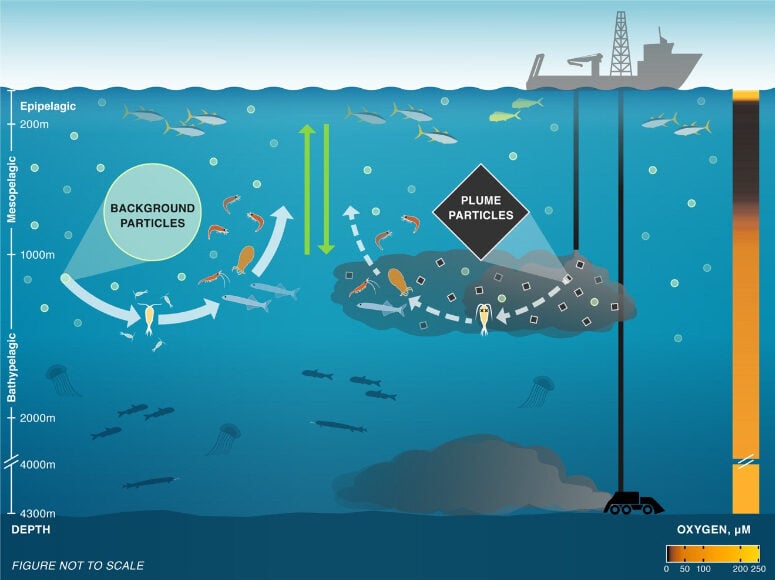
“When the waste released by mining activity enters the ocean, it creates water as murky as the mud-filled Mississippi River,” says lead author Michael Dowd, an oceanography graduate student. “The pervasive particles dilute the nutritious, natural food particles usually consumed by tiny drifting zooplankton.
“Micronekton, small shrimp, fish and other animals that swim feed on zooplankton. Some migrate between the depths and near surface waters and they are consumed by fish, seabirds and marine mammals. Zooplankton’s exposure to junk-food sediment has the potential to disrupt the entire food-web.”
Mining trial
The study investigated the content and effects of waste matter released in the midwater CCZ during a 2022 mining trial. About 1.5 million sq km of the CCZ is under licence for deep-sea mining of polymetallic nodules that contain valuable minerals such as cobalt, nickel and copper.

In the race to meet demand for metals needed for electric-car batteries and other low-carbon technologies, the mining operators plan to pipe nodules up from the deep seabed to a collection ship for separation from the accompanying sediment, pulverised nodule particles and seawater.
This waste would be released back into the ocean in the Twilight Zone – even though the impact on this proposal has only now been scientifically studied.
The krill, fish, squid, octopus, jellyfish and other denizens of the zone rise towards the sea surface at night and swim back down in daylight, thereby supporting the vital transport of carbon to the depths.
They either feed on particles in the Twilight Zone or prey on those creatures that do, with the resulting food-web connecting the surface ocean to the abyss, say the scientists.
When the researchers tested water samples collected from the depths at which the mining waste had been discharged, the particles were found to contain far lower concentrations of amino acids – a key indicator of nutritional value – than would naturally occur.
‘Dumping empty calories’
“This isn’t just about mining the seafloor; it’s about reducing the food for entire communities in the deep sea,” explains study co-author Prof Erica Goetze, a marine zooplankton ecology expert. “We found that many animals at the depth of discharge depend on naturally occurring small detrital particles – the very food that mining plume particles replace.”

“Our research suggests that mining plumes don’t just create cloudy water – they change the quality of what’s available to eat, especially for animals that can’t easily swim away,” says deep-sea ecologist Prof Jeffrey Drazen, another co-author. “It’s like dumping empty calories into a system that’s been running on a finely-tuned diet for hundreds of years.
“Before commercial deep-sea mining begins, it is essential to carefully consider the depth at which mining waste is discharged. The fate of these mining-waste plumes and their impact on ocean ecosystems varies with depth, and improper discharge could cause harm to communities from the surface to the seafloor.”
The UH team hope that their findings will inform international regulatory decisions currently being shaped by the International Seabed Authority and the National Oceanic and Atmospheric Administration (NOAA), which is responsible for reviewing environmental impacts of US-led deep-sea mining initiatives. The report is published in Nature Communications.

Such concern for a small mining operation. For decades humans robbing the sea by overfishing, destroying habitats , dolphins and whales murdered, plastics and microplastics now in our food and the list goes on and nothing gets done about it and you’re fussing about plankton! If it’s going to help save the climate let it go ahead I say.