Agreement has been reached to provide significant new protection for some of the world’s most threatened shark species, marking what influential US organisation the Wildlife Conservation Society (WCS) describes as a major step forward for ocean conservation.
A series of proposals were adopted on 29 March at Campo Grande, Brazil between governments attending CoP15 (the 15th Conference of the Parties) to the Convention on the Conservation of Migratory Species of Wild Animals (CMS).
New CMS Appendix listings now offer full protection for all three thresher and two species of hammerhead sharks, top predators in ocean ecosystems. Parties to the agreement are now obliged to impose national prohibitions on catching these species.
“Iconic ocean wanderers like large hammerheads and thresher sharks that are already assessed by the IUCN as threatened with extinction should be fully protected – and these CMS Appendix I listings are an important recognition that this should happen now,” said Dana Tricarico of the WCS’s global shark conservation team.
“These listings recognise that slow-growing Endangered shark species should be treated like other marine wildlife such as sea turtles or dolphins, and these listings should drive that action – but success will depend on how quickly and effectively countries implement these new obligations at a national level.”
Threshers and hammerheads
Pelagic, bigeye and common thresher sharks, the three species championed by Panama, have all suffered severe global population declines. Highly migratory, threshers move across territorial and international waters so face intense fishing pressure as both target and bycatch, especially so because their reproductive rates are so low.
All three species are now listed on CMS Appendix I, requiring strict national protection measures across their range.
The same applies to the scalloped hammerhead shark, populations of which have declined sharply because of overfishing, bycatch and international trade in shark-fins.
The species’ complex life-cycle spans coastal nurseries, seamounts and offshore aggregation sites across multiple jurisdictions, making co-ordinated national and international protection essential, says WCS.
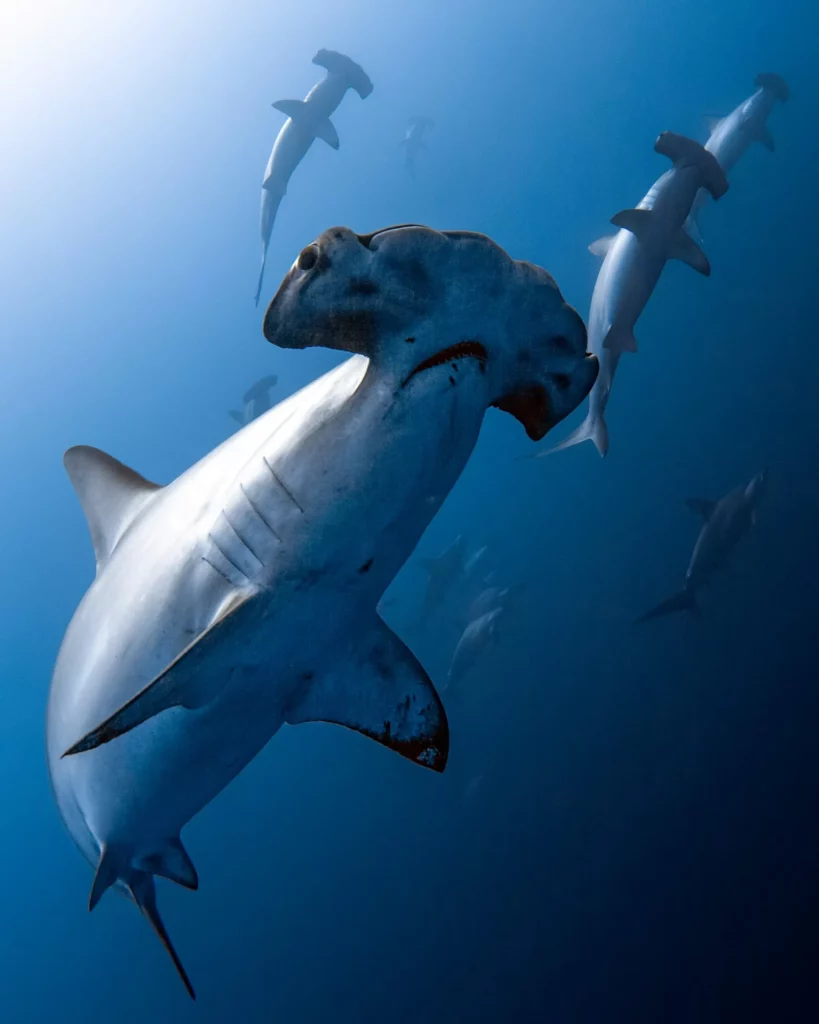
Both the scalloped and great hammerhead shark are Critically Endangered and were championed at CoP15 by Ecuador. They are now listed on CMS Appendix I, recognising severe population declines driven by unsustainable fishing and high-value trade.
The great hammerhead is a highly mobile species that undertakes long-distance movements across ocean basins and depends on strong protection across its full range.
Narrownose smoothhound
In South America, where CoP15 was held, WCS teams work with governments and fishing communities to reduce unsustainable pressure on vulnerable coastal shark species such as the Patagonian narrownose smoothhound, one of the most heavily landed sharks in Argentina and Uruguay. The species has suffered population declines exceeding 80% over three generations.
“This species supports small-scale coastal fisheries, caught both intentionally and as bycatch,” said Juan Martin Cuevas, the WCS shark and ray co-ordinator in Argentina. “But their populations and the communities that depend on them are increasingly at risk without co-ordinated management.
“Since 2022, WCS teams have been working alongside local partners to monitor these fisheries, helping to identify trends and support science-based management in close collaboration with communities – and we will continue to do so to implement these new listings.”
Brazil proposed the Patagonian narrownose smoothhound for protection and it is now listed on CMS Appendix II, which strengthens regional co-operation.
The listing is expected to support better monitoring, data sharing and fisheries management, a co-ordinated approach considered essential to allow both species to recovery while sustaining coastal livelihoods.
Protection measures
Shark and ray conservationists celebrated last November as sweeping new international trade protection measures for diver-favourite species such as oceanic whitetips, whale sharks and manta rays were voted in at the CITES CoP20 talks in Uzbekistan.
CMS and CITES complement one another, with CMS focusing on protecting migratory species across borders, with binding legal force but co-operation-based enforcement.
CITEs regulates international trade in endangered species and is more visible, covering tens of thousands of species (animals and plants) with direct enforcement powers through a system of permits and bans and generally higher visibility.