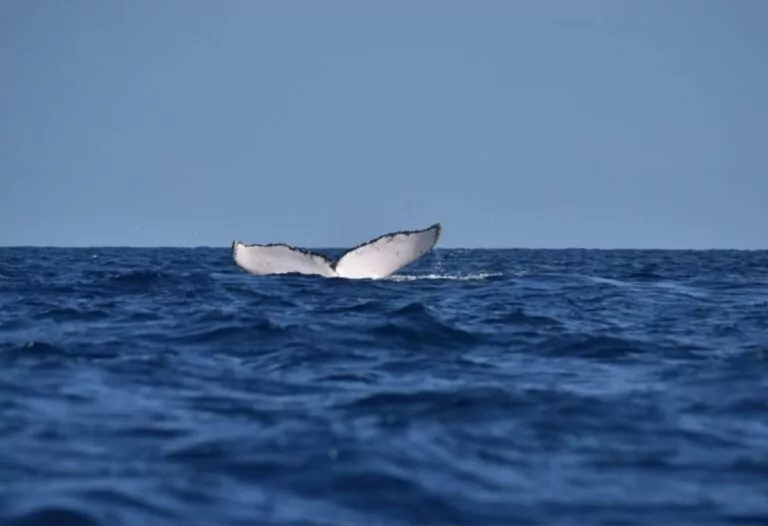
One of the longest known migrations of any mammal, and surprising even by the standards of wide-ranging humpback whales, has been documented by an international team of researchers with the help of citizen-scientists.
Humpback whale (Megaptera novaeangliae) migration routes are known to extend over long distances between north and south, from tropical breeding grounds to cooler feeding grounds, but the populations tend to remain separate longitudinally, and highly loyal to their habitual feeding grounds.
In the Southern Hemisphere there are seven known breeding populations and until now there was not thought to be much overlap between them.
Company of females
Now the team has recorded what it says is the longest documented distance between sightings of a mature male humpback, seen on the wintering grounds of two different ocean basins.
He was first observed in the eastern Pacific off Colombia in 2013 and 2017, and then five years later near Zanzibar in the south-western Indian Ocean, by which time he was thought to have been at least 15 years old.
The sightings all occurred around breeding season and showed the whale in the company of females. With the two breeding stocks separated by 120° of longitude, the distance the whale had to cover between them was a minimum of 13,046km.
Citizen-scientists as well as scientific researchers contributed to the study through the multiple photographs submitted to the website Happywhale, which identifies the animals by their individual flukes and has a database containing more than 100,000 images
The exceptional migration might have been driven by climate change depleting stocks of the krill on which the whales feed, say the scientists. However, another theory is that, as whale populations continue to recover since the 1980s hunting moratorium observed by most countries, it might have become more difficult for males to compete to find a suitable female within their usual grounds.

Dr Ekaterina Kalashnikova of the Tanzania Cetaceans Program led the study, and she says that the whale’s journey represents the longest distance a humpback whale has ever been recorded travelling.
The study was said to underline the importance of “transboundary research effort and citizen science to understand potential drivers and population impact of interoceanic movements of humpback whales”. It is published in the journal Royal Society Open Science.
Also on Divernet: Humpbacks’ homosexual encounter caught on camera, Alien-hunters inspire world-first chat with whale, UK seas “a service station” for humpbacks, Humpback Hits: Catchy songs could circle world