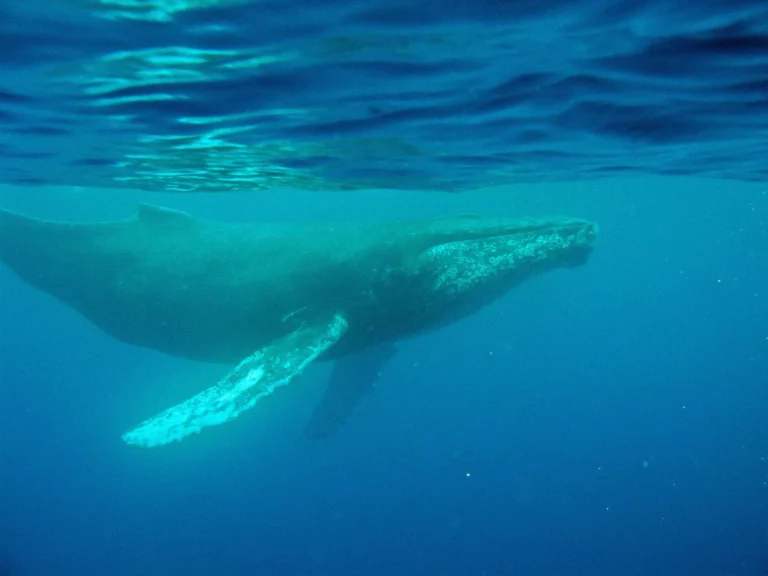
For 77 years a fragile “audograph disc” lay forgotten – but now it is has turned out to contain what is thought to be the earliest preserved recording of a whale, say researchers at the Woods Hole Oceanographic Institution (WHOI) in Massachusetts.
The humpback’s calls were captured near Bermuda on 7 March, 1949 from WHOI’s first research vessel Atlantis. WHOI and US Office of Naval Research scientists had been testing sonar systems and conducting other acoustic experiments, but had no idea at the time what the underwater sounds they could hear were.
The relative lack of background noise on the recording is said to underline how much quieter the ocean was in the late 1940s, and will help scientists to understand how factors such as increased shipping noise have affected whale communication.
The well-preserved disc, only recently discovered in WHOI’s archives, has now been digitised. In 1949 technological advances were just beginning to enable recordings of underwater sound and launch the science of marine-mammal bioacoustics, says the institution.
Also in 1949 WHOI scientists William Schevill and Barbara Lawrence recorded belugas in Canada’s Saguenay River using a crude hydrophone and a dictation machine but most such recordings from the period are poorly preserved or inaccessible. Widespread awareness of baleen whale song emerged only in the late 1960s through the work of Roger Payne.
Gray Audograph
“The ocean is much louder now, with increases in both number and types of sound sources,” says WHOI marine bio-acoustician Laela Sayigh. “This recording can provide insight into how humpback whale sounds have changed over time, as well as serving as a baseline for measuring how human activity shapes the ocean soundscape.”
The recordings were made using a Gray Audograph, an office dictation device that etched audio onto thin plastic discs rather than magnetic tape, in this case probably using an experimental underwater acoustic recording system called the “WHOI suitcase”. The discs are said to have lasted better than tapes would have done.

WHOI has been working with Ocean Alliance, which has an archive of more than 2,400 recordings of whale and ocean sounds collected from the 1950s through to the 1990s, to place the 1949 recording in context.
Nowadays WHOI scientists use technology such as passive acoustic buoys and autonomous hydrophones to monitor ocean acoustics, generating vast datasets that are used to study marine life, track human impacts and understand long-term environmental change.
Current data-collection systems include the WHOI-led Robots4Whales programme, which uses autonomous ocean robots equipped with the Digital Acoustic Monitoring Instrument (DMON) to detect whales in real time and identify their calls by analysing how the sound frequency changes over time.
“Underwater sound recordings are a powerful tool for understanding and protecting vulnerable whale populations,” says another WHOI marine bio-acoustician, Peter Tyack. “By listening to the ocean, we can detect whales where they cannot easily be seen.
“At the same time, these acoustic tools let us track how human activity, from shipping noise to industrial sounds, changes the ocean soundscape and affects the way whales communicate, navigate and survive.”
The WHOI Archives recently received a $10,000 award from the National Recording Preservation Foundation to digitise its audograph collection and make it more accessible both to researchers and the public.