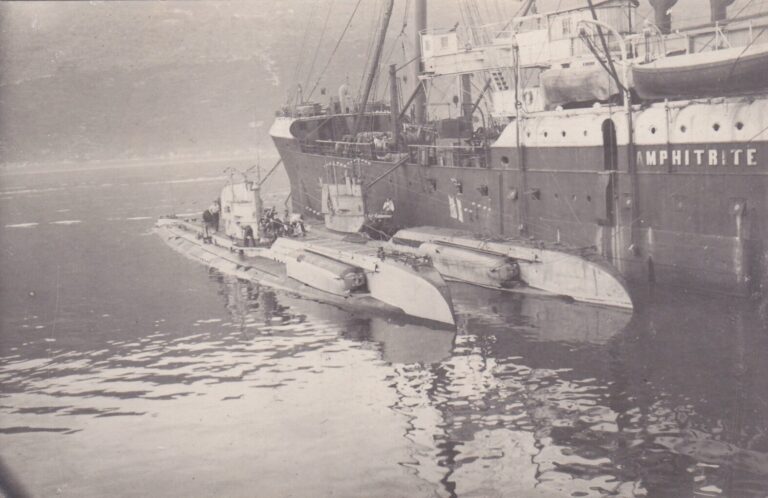
Kendall McDonald believes the Yorkshire sub hunters may have solved an 80-year-old mystery about UC-47´s presence at the surface the morning she was sunk.
The Mystery of UC-47’s Surface Sighting
It has always been a mystery why Oberleutnant Wigankow allowed himself to be caught on the surface in the raw dark just before dawn on November 18,1917. But Shaun Carr and his team have probably found the answer by reporting the extended telescopic radio mast of UC-47.
Communications between the U-boats of the Flanders Flotilla, when hunting in the North Sea, and their headquarters at Bruges were always difficult. Without the radio masts fully extended, wireless range from the low hull of the submarine was about 30 miles, which meant that Wigankow would have had to rely on other boats nearer home passing on his messages.
With the masts fully raised – this could be done from inside the boat by small electric motors – the radio range was increased to well over 100 miles.
So it is likely that Oberleutnant Wigankow was trying to pass some message back to Bruges when he was spotted.
Oberleutnant Wigankow and UC-47’s Combat Record
Wigankow was not inexperienced. He had commanded the two attack boats, UB-12 and UB-17. Once on UC-47, he torpedoed two ships familiar to Yorkshire divers on his first mission to the south-east of Flamborough Head – the 1057-ton British steamer Togston and the Australian Cadmus of 1879 tons.
On his second mission to the same area he sank the French Isabelle and the British Ballogie (another wreck well-known to local divers), before sinking the Dana, whose wreck has also been found.
Wigankow left Zeebrugge on November 17 with orders to attack shipping on der englischen Ostkuste vor Flamborough Head und weiter sudlich.
It was 6.23 the following morning and still dark when UC-47 was found by HMS P-57. This was one of 60 patrol boats designed to hunt submarines. It had bows of hard steel for ramming U-boats, a 4-inch gun, pom-poms and two special depth-charge throwers.
HMS P-57’s Bold Attack
Her commander, H. C. Birnie, had just challenged a steamer by pinning her in his searchlights, but almost immediately saw she was friendly. As he put out the lights and turned away, a lookout shouted that there was a big buoy on the port bow.

Birnie was puzzled – there should be no buoys in the area. He altered course again.
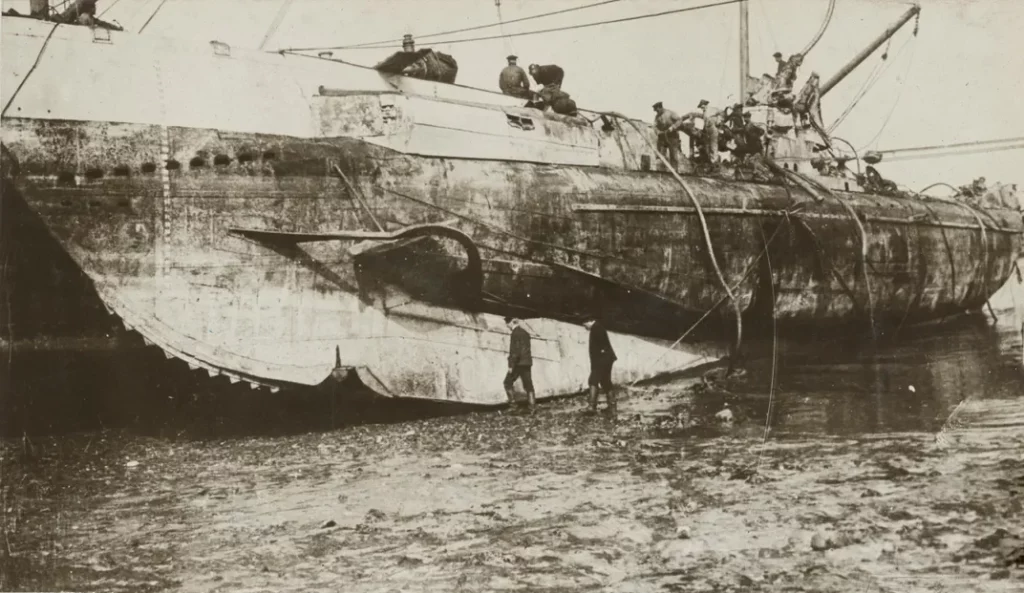
Almost immediately he and the officer of the watch, Lieutenant Isdale, saw that the big buoy was Wigankows conning tower. The sub was now only 200 yards away. P-57 swung violently to port at Birnies command and her engines raced to full speed ahead.
She was capable of 20 knots, but had hardly got to that speed in the 15 seconds before her bow bit deep into UC-47, just before the conning-tower and almost at a right-angle to the hull. The force of the attack drove the submarine down and away and she started to pass astern of Birnies boat.
The crew of P-57 quickly released a depth charge. Birnie turned his ship, came racing back over the U-boat and dropped another charge. Turning again, he dropped a marker buoy into the middle of the turmoil and waited.
Soon oil was coming to the surface close to the buoy and the patrol boat sent down another depth charge into the source of the slick, followed by another buoy.
P-57 patrolled around for the rest of the day and the next night but none of the U-boats 26 crew came to the surface. A minesweeper arrived, hooked her with a chain sweep with an explosive charge and detonated it.
Aftermath and Historical Significance
A day later Navy divers went down to the wreck, entered her despite their hard-hat gear, and recovered charts of the minefields she had laid on earlier operations.
Commander Birnie was awarded the DSO and the Admiralty gave the standard reward for a kill of£1,000 to be shared by his crew.
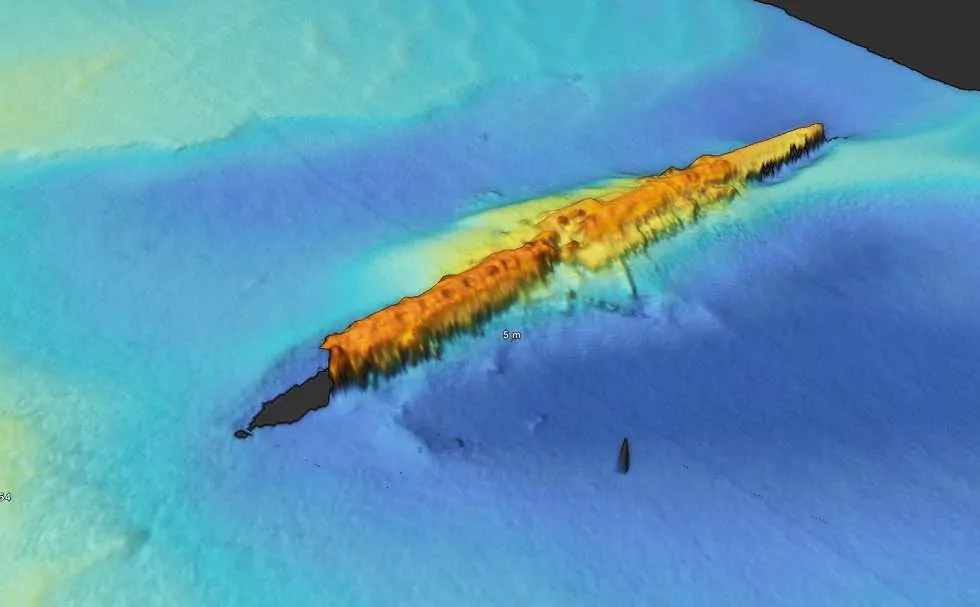
The wreck was discovered and surveyed in 2020.
FAQs
What happened to UC-47 in 1917?
UC-47, a German U-boat, was rammed by HMS P-57 off Flamborough Head on November 18, 1917, leading to the loss of all 26 crew members.
Why was UC-47 on the surface before it sank?
Evidence suggests Oberleutnant Wigankow extended the submarine’s telescopic radio mast to transmit messages back to Bruges, exposing the U-boat to detection.
Who commanded HMS P-57 during the UC-47 incident?
Commander H.C. Birnie led HMS P-57, using skillful manoeuvres and depth charges to ensure the destruction of UC-47.
What ships did UC-47 sink before being rammed?
UC-47 sank several vessels including the British steamer Togston, Australian Cadmus, French Isabelle, British Ballogie, and Dana.
What happened to the wreck of UC-47?
Navy divers recovered charts and investigated the wreck, confirming her fate and mine-laying operations.
Subscribe today with promo code DIVE1 — enjoy 12 months for just £1!