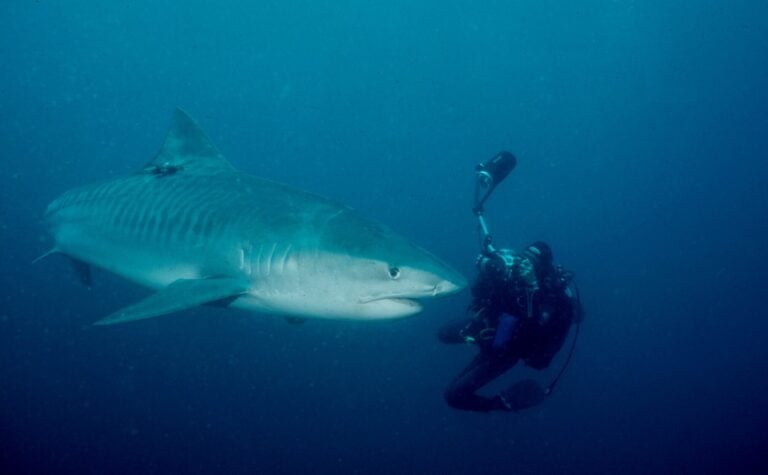
PIERRE CONSTANT goes on a tiger shark hunt in South Africa, though for a while it looks as if the elements will refuse to play ball
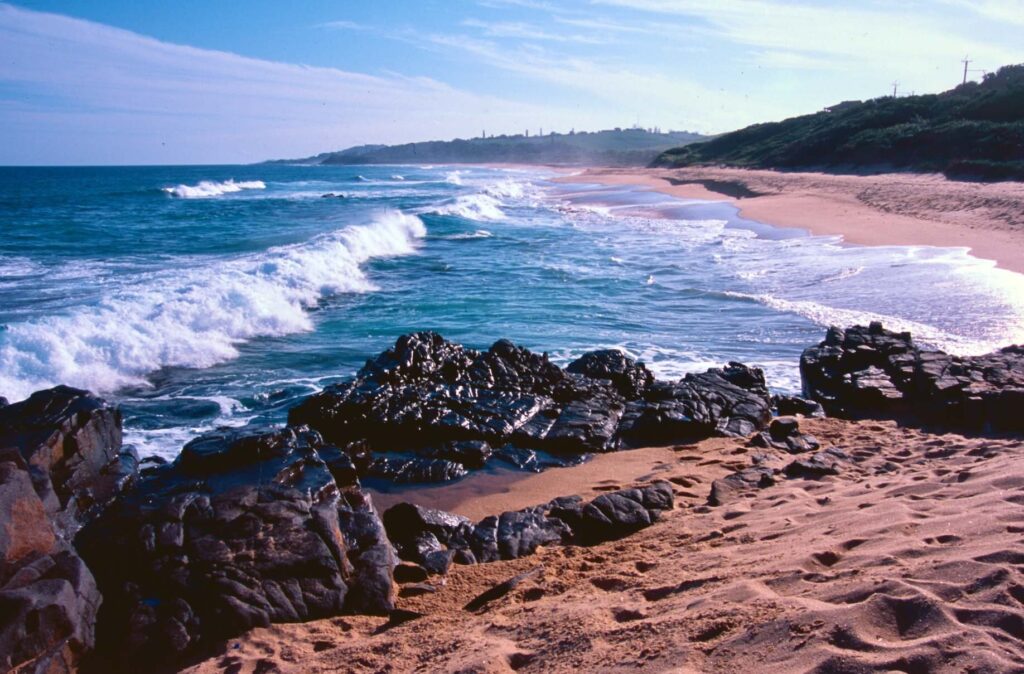
Planted with palm trees and Norfolk pines, the small town of Umkomaas is 40km south of Durban, on the KwaZulu-Natal coast. Built on lush green heights, the city faces the open space of the Indian Ocean.
The South African eastern shores seem to stretch endlessly, a succession of long white sandy beaches and granitic rocky capes, where the surf of the great blue yonder comes crashing and rolling in barrels of foam.
Exposed to the oceanic winds, the coast was devastated by a powerful cyclone coming from Madagascar, and the tar road collapsed onto the beach below.
While his armies plundered Pondoland in 1828, the great chief and warrior Shaka Zulu gave this site the name of Umkhomazi, which in the Zulu language means “River of the Cow Whales”.
Whales used to come up the river into fresh water but nowadays the river mouth is too shallow. However, every year from May to August the east coast of KwaZulu-Natal witnesses a big gathering of humpback whales migrating up from Antarctica to Madagascar to breed.
They head south again with their calves between September and December. Minke whales join the club, as well as southern right whales, which follow the annual “Sardine Run” in July and August.
The ruins of the Norwegian whaling industry are still visible – the Park Renie whaling boats that operated from 1915 to 1929. Strandlopers, prehistoric men of the San or Khoïkhoï tribes, used to stroll down the beach to look for stranded whales and sea-lions on which to feed.
South Africa’s sharks
South Africa’s waters are rich in marine life. Imagine a collection of 2,000 species of fish! More than half of these are tropical or subtropical species of the Indo-Pacific, 4% come from the Atlantic and 13% are endemic to South Africa. An amazing 100 species of sharks inhabit those waters – a third of all those on the planet – though many are in very deep waters.
The shores of KwaZulu-Natal are bathed by the Agulhas Current, a warmwater stream that branches off the South Equatorial Current, with a global north-east to south-west direction.
In the Cape of Good Hope region this current vanishes – with a few eddies – as it meets the Benguela Current, a coldwater mass that flows north from Antarctica along South Africa’s west coast towards Namibia and beyond.
These two currents create, according to their intensity, winter or summer, and this explains the distribution of fish populations, including those of the sharks.
Species such as the great white, mako, copper shark aka bronze whaler, smooth hammerhead and smaller benthic species prefer the cold waters of the Cape or the Transkei.
Others choose the warm environment of KwaZulu-Natal and Mozambique, including the fearsome Zambezi or bull shark, the dusky, Java and oceanic blacktip, the scalloped and great hammerhead… and the tiger shark.
The Natal coast has gained a sinister reputation as a result of bathers being bitten by sharks. Shark-nets were first installed off Durban in 1952.
In the 1940s, ’50s and ’60s most incidents in South Africa occurred in KwaZulu-Natal, and today 40km of nets are located at 37 localities along 325km of its coastline. It’s the only province equipped with shark-nets and, according to the Natal Shark Board, these capture between 800 and 2,200 sharks a year.
Water-users are not 100% protected, and on average four shark incidents occur in South Africa every year, out of 70-100 worldwide. One in nine results in a serious injury, and one in 15 is fatal.
From 1987 the reefs of Aliwal Shoal, south of Durban, started attracting a new breed of divers that came to dive with the raggies or raggedtooth sharks (Carcharias taurus). These are variously called grey nurse sharks in eastern Australia and sand tigers in the USA.
Aliwal Shoal’s heyday is over, I am told, the place spoilt by the presence of too many divers. Pristine new reefs have been discovered by a fresh wave of operators, some from overseas.
The shark couple
Dietmar Posch had always wanted to be a swimmer, and was part of Austria’s Olympic team. As project manager for a resort in Mexico’s Playa del Carmen in 1992 he started diving with mako, grey reef and nurse sharks in the Gulf of Mexico and became a shark enthusiast.
After five years he returned to Europe, obtained his professional dive certifications with PADI, ANDI and TDI and got into underwater videography.
He worked for Austrian and German TV and the BBC before taking off to the Red Sea, where he met his Italian partner Raffaella, an underwater photographer. Seduced by the idea of working with tiger sharks, the couple decided to settle in South Africa in early 2004.

“We must prepare the rabbadak…”, declares Raffaella, in her strong Italian accent.
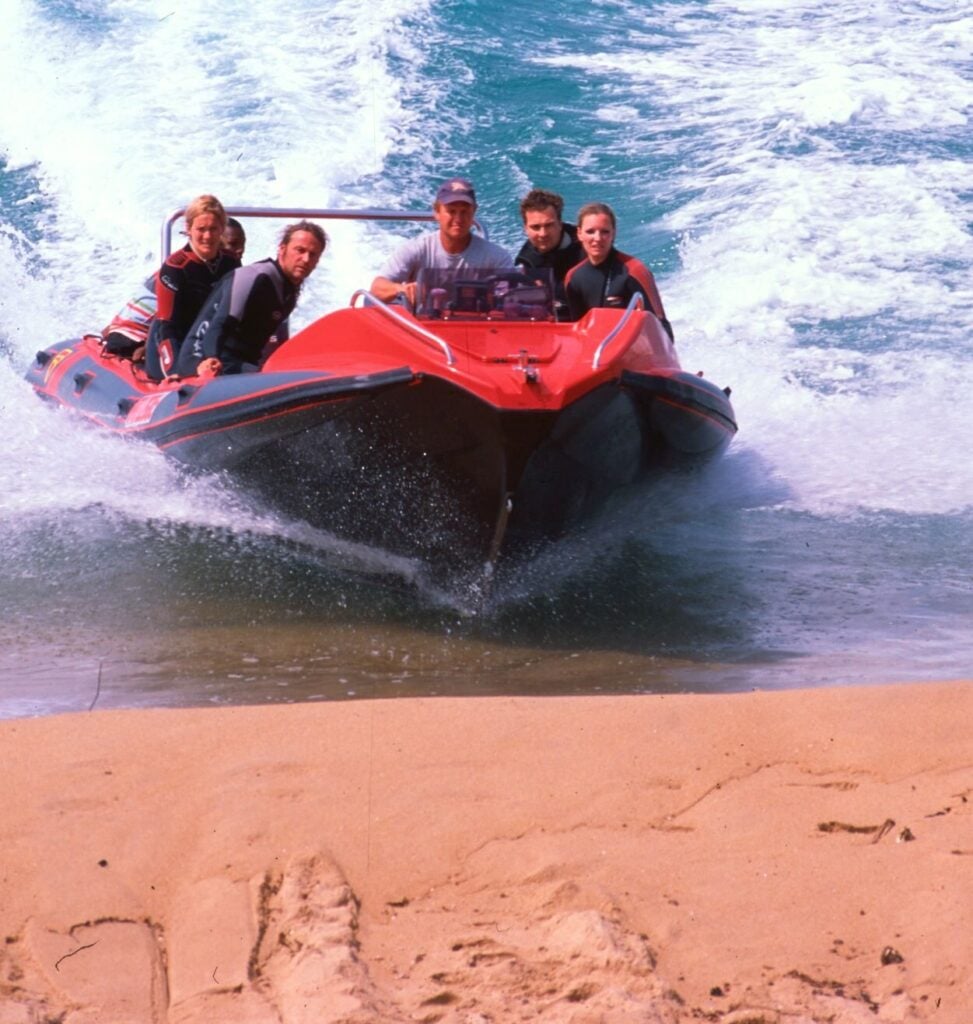
“Rabbadak? What is that?” I ask, puzzled. The explanation is given by John Miller, skipper of the boat. The rubber duck is a 7.5m RIB with a glass-fibre hull, the typical choice for South African beach-launch diving.
Equipped with two 85hp Yamaha outboard motors, it can carry eight divers. Flashy red with sooty grey floats, the boat sports a characteristic ‘beak’.

We head for Rocky Bay, 12km south of Umkomaas, where the long sandy beach ends with a few granite boulders. On a trailer behind the Land Cruiser 4×4, the rubber duck goes backwards into the deep sand of the beach and is dropped at the water’s edge.
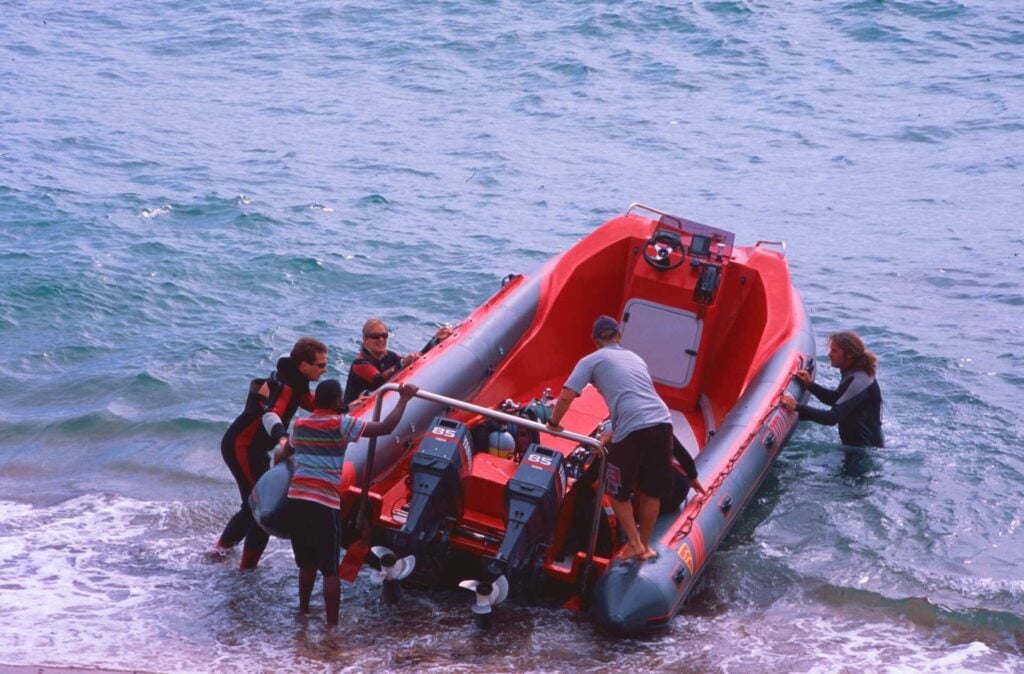
The rolling surf growls in the background, a warning of the fun to come. The divers push the boat into the water before hopping in swiftly. “Slip your feet into the footholds of the floor and grab the ropes on the sides!” yells John.
We speed across the wave and come out of it drenched to the bone, with an expected slam of our collective backsides. Everyone breaks into laughter.

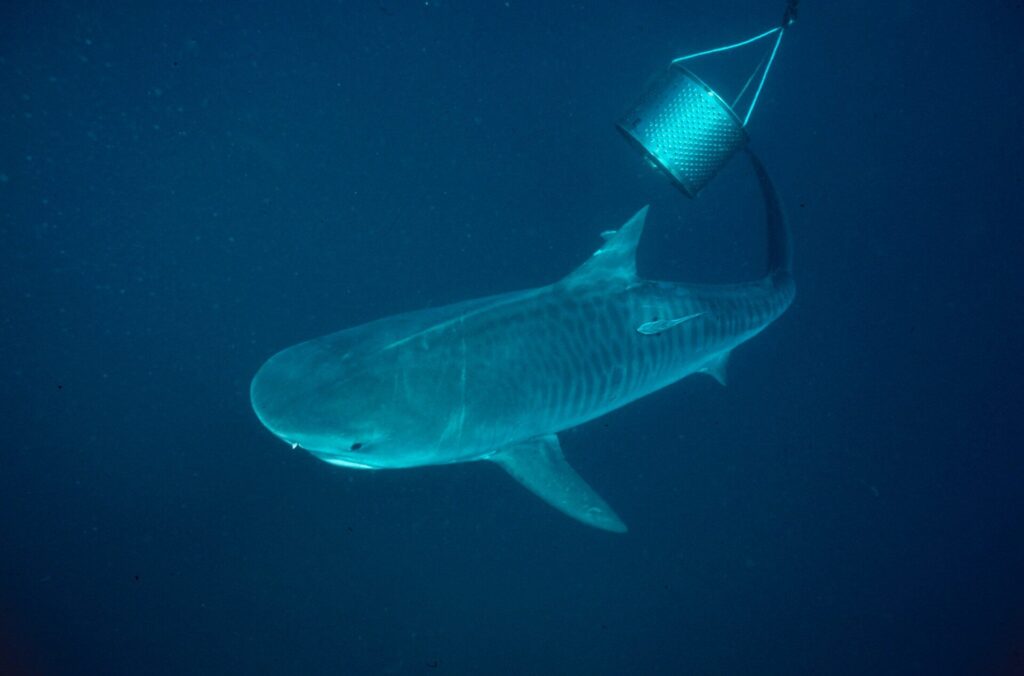
Castle Reef is 2km away. Dietmar fills an old washing-machine drum with dorado carcasses and sardines. “This is the food basket that will attract tigers,” he says. Four packs of frozen sardines are piled at the back.
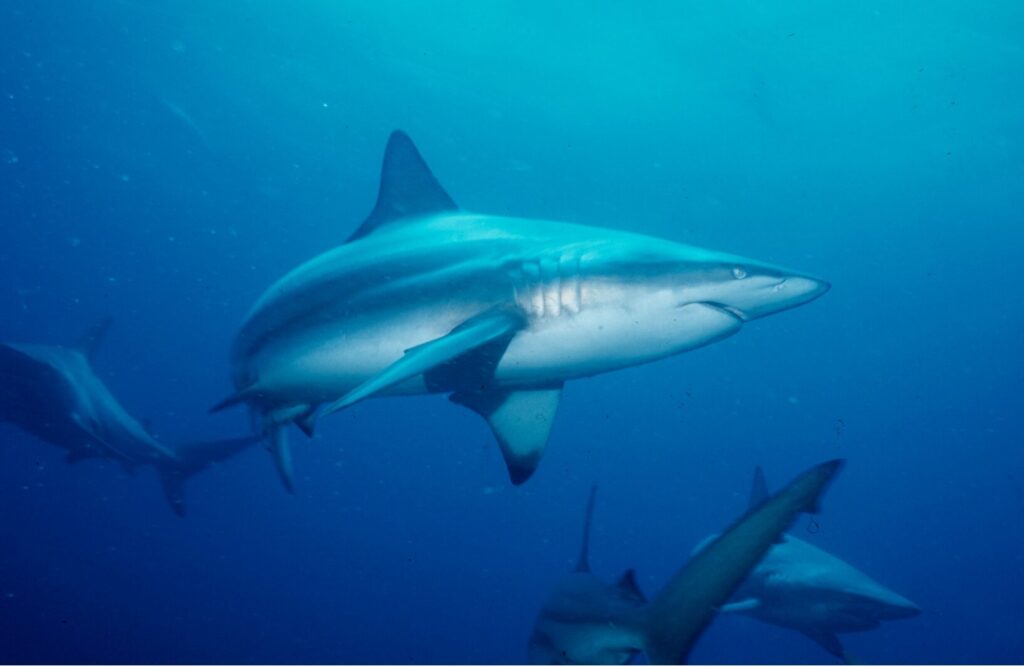
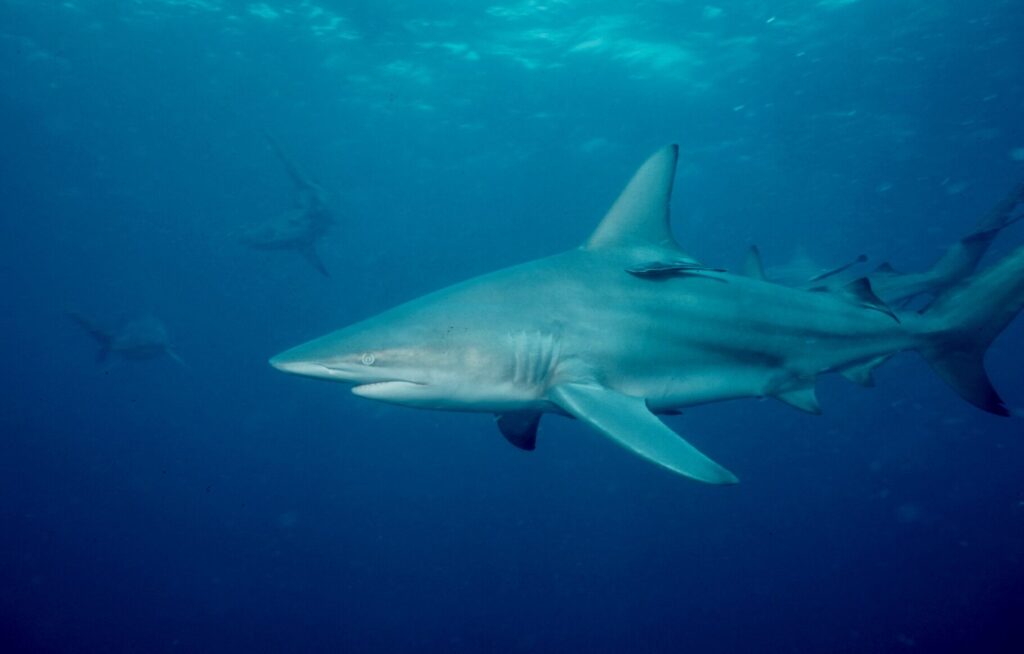
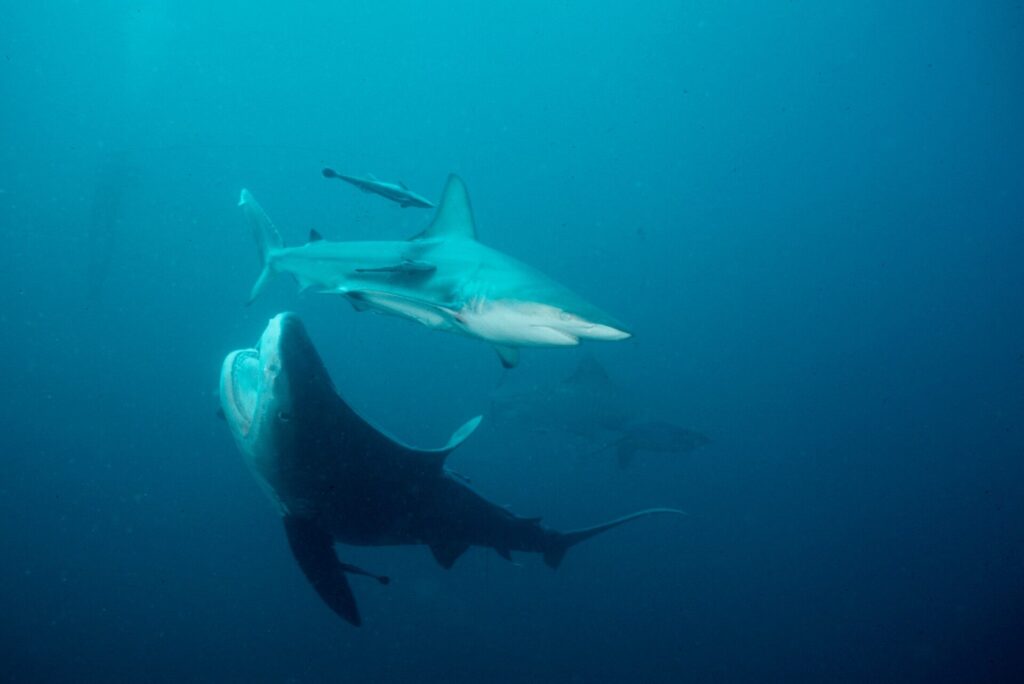
Tied to a chain and a buoy, the basket is lowered about 8m below the surface, and Dietmar throws pieces of sardines overboard as bait. Furtive shadows appear quickly beneath the surface – oceanic blacktip sharks (Carcharhinus. limbatus) and dusky sharks (C obscurus), 1.5-2m long.
“I need to give you a small briefing before we jump in,” says Dietmar as the site starts to swarm with sharks. “We will slip into the water one by one without a splash… whatever happens, you must remain calm and relaxed… stay together at a depth of 8-12m max to avoid a curtain of bubbles.
“If a shark comes too close, push it gently on the nose or the gills, it will turn away at once”. Easy to say, mate.
Dietmar demonstrates the aggressive displays of sharks: the arched back, the pectoral fins vertical, sudden lateral convulsions of the body.
“After 45 to 60 minutes, the tiger shark may display an aggressive behaviour, it may have an interest in your first stage, in your colourful fins [yellow or silver], or in any shiny object that reflects the light. If that is the case, we will exit the water immediately.”
Into the water
Everybody nods in agreement. We slip under the surface, like ghosts. Sharks are everywhere, extremely inquisitive. No fear whatsoever, swarming about like a cloud of butterflies between the ‘basket’ and the surface.
Some swim in circles, others zoom in on me and divert at the last moment. Others pass by less than a metre away, just enough to provoke anxiety.
The duskies are light brown and about 2m long, with a round snout and also distinguished by a dorsal fin set behind the pectorals. An interdorsal ridge or keel is conspicuous behind the two dorsal fins. The pelagic blacktips (C limbatus) have a pointed snout, black-tipped fins and an arched back.
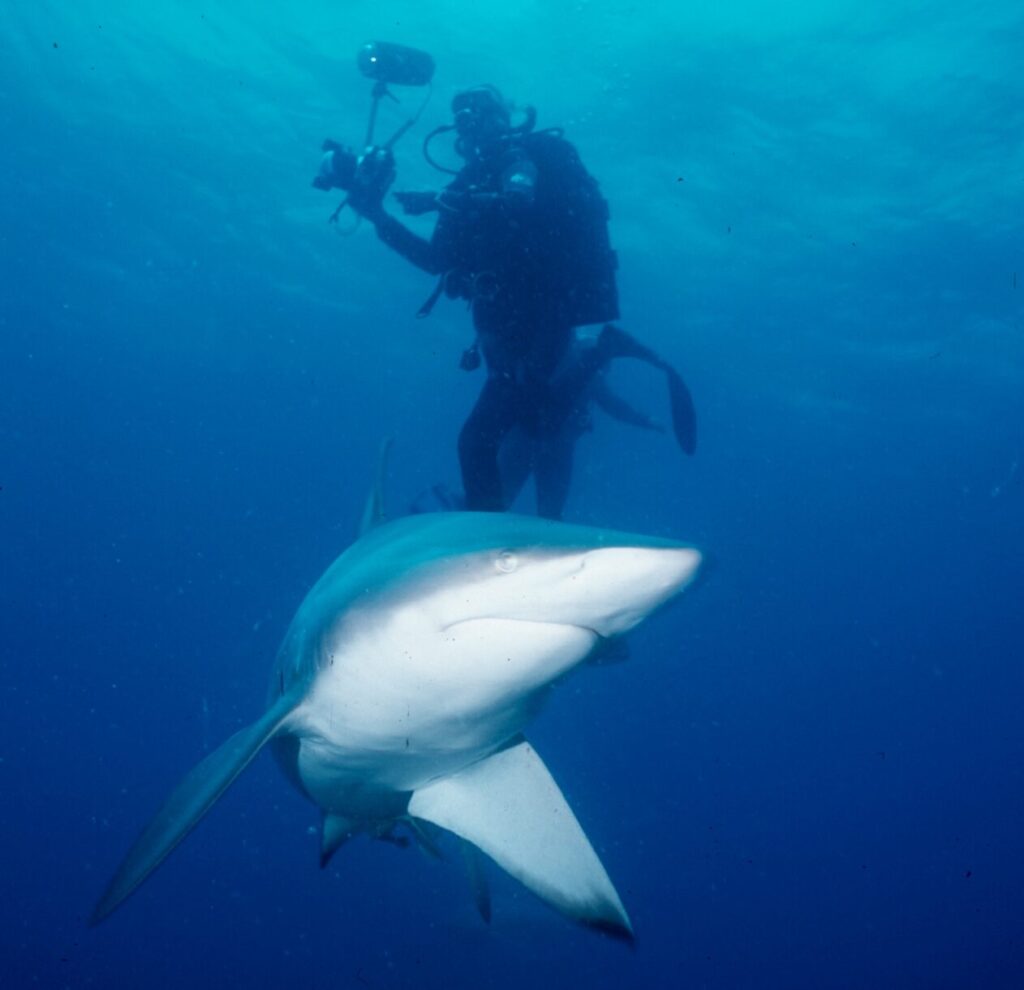
Forty minutes pass but there is no sign of a tiger shark today. Back on the rubber duck, Dietmar feeds the leftover sardines to the sharks.
Weather intervenes
Next day the weather is uninviting, with black sky and rain, and the diving is cancelled. As a consolation, Raffaella takes us to the uShaka Aquarium in Durban, which is well worth a look.
It’s the same story the following day, with constant misty rain and the water dirty. “This is nature, you know…”
The next day brings clear skies but the current is not in our favour, and visibility is poor. We all feel quite miserable. “No diving today,” laments Dietmar.
Some of us are turning sour and pessimistic, but on the fourth day the conditions are acceptable. The Agulhas Current is running north-south, visibility is fine and the smiles return: “Let’s go!”
In South Africa, oceanographic and meteorological conditions are hard to predict and can change drastically from one day to the next. It is wise to plan a few extra days to avoid disappointment.
The ocean is lake-flat and the water cobalt blue. Dietmar brings down the food drum and pours overboard the chum, a smelly mix of fish oil, blood and viscera to leave a trace in the mild current. This will, we hope, encourage the tiger to make its way to the source.
“We do not want to promote adrenaline dives, feeding the sharks in excess, but we do need a minimum to attract them,” says Raffaella.
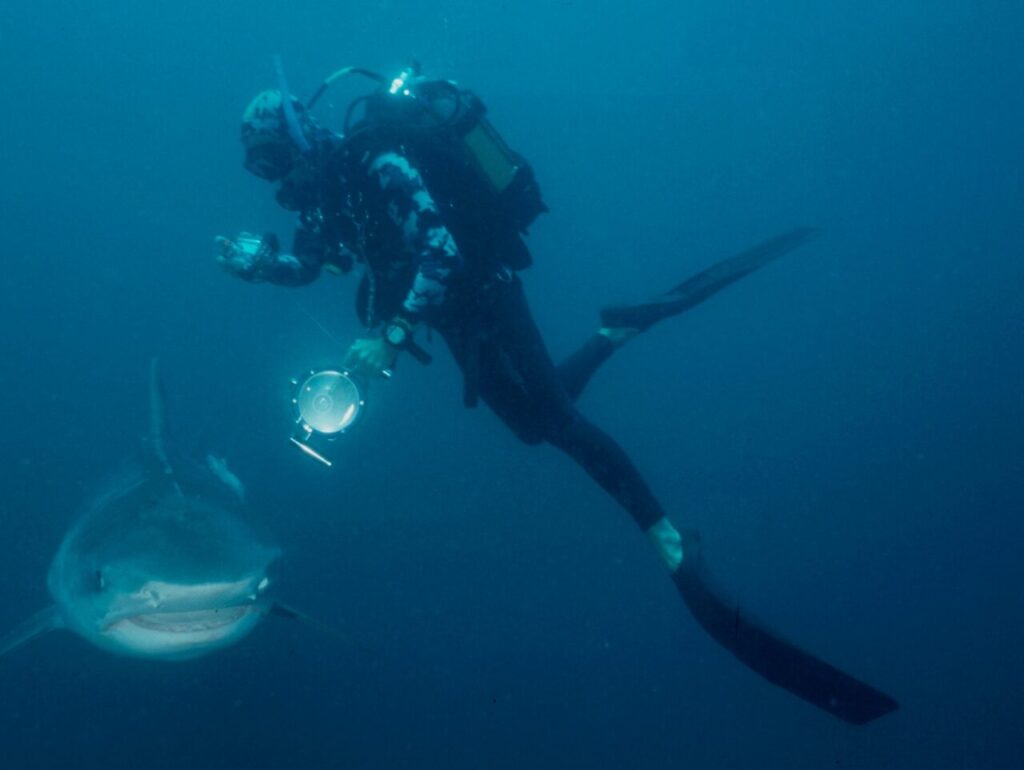
A few minutes later I am under water, close to the hanging basket. Some sharks circle at the surface as I stare into the blue. Nothing happens in the first 10 minutes, then suddenly a swift shadow glides from behind and comes alongside me. Startled, I shiver automatically.

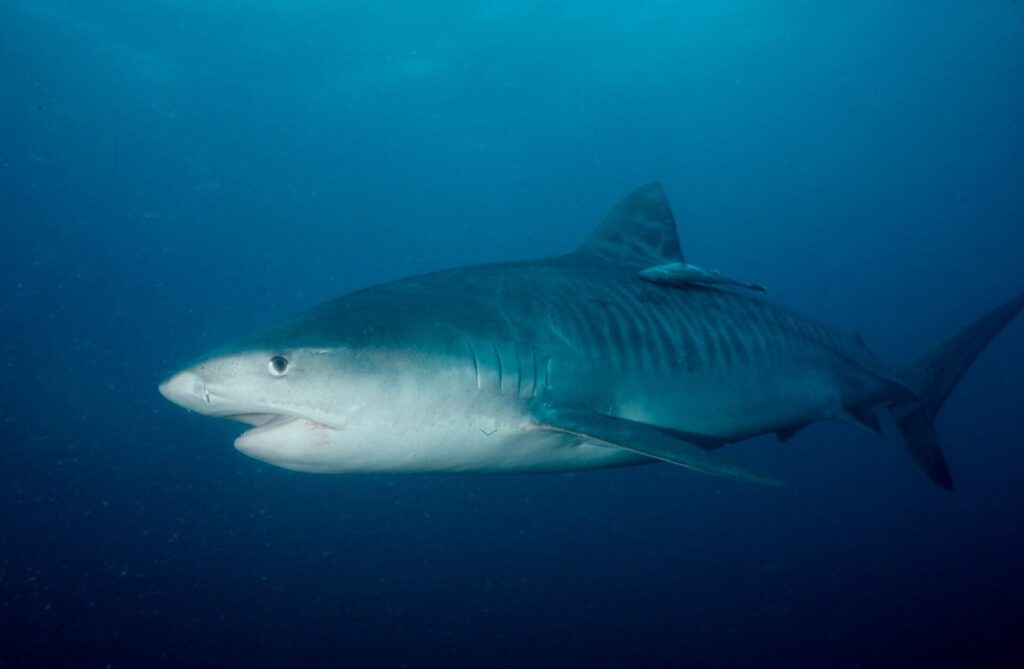
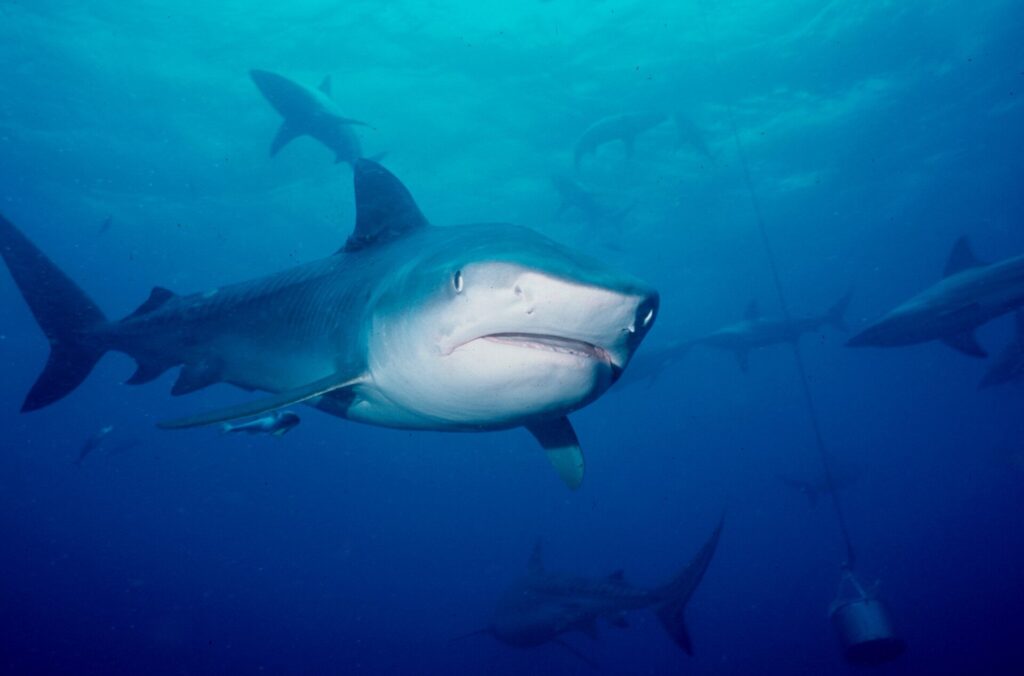
The shark is big, 4m perhaps. It disappears right away, but returns five minutes later, again from behind me. This time I have time to take in its lateral stripes.
I try to control my emotions; the vision is phantasmagoric. The shark’s movements are slow and elegant, almost catlike, and very graceful. I feel breathless. The beast of such an awful reputation is in front of me, its black eyes looking into mine.
With that conspicuous blunt snout, I have seen nothing like it before. The white nictitating membrane outlines the eye like a crescent moon.

Without aggression the tiger shark sniffs the basket, then comes towards me. It returns to the basket, trying to bite into it, catches the chain and shakes it.
“We used a rope in the past,” Raffaella has said, “but the tiger could cut it. Once, the basket fell. I tried to recover it, but the tiger attacked it between my legs. I had to let go, because it became rather nervous”.
Shark behaviour
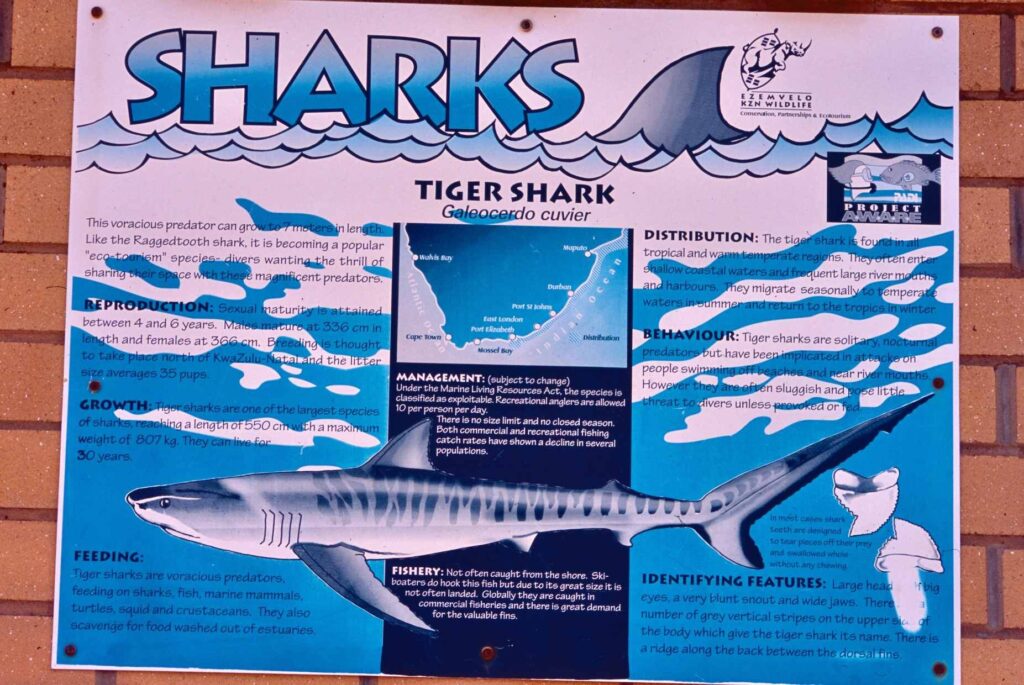
Tiger sharks like warm water and are usually found from Mozambique to KwaZulu-Natal between December to April. They frequent inshore waters and murky estuaries. Sexual maturity is reached at 4-6, and breeding takes place in the north of Natal.
A typical litter has some 35 pups, each one 60cm long at birth. Maximum size of adults is 7m, weight 800kg and average lifespan is 30 years.
Opportunistic feeders, they are generally solitary and most active at night. These scavengers will feed on anything from marine mammals to turtles, seabirds, fish and cephalopods. Serrated teeth enable the tiger to cut and tear flesh effectively. They might also ingest tin cans, plastics and all that glitters.
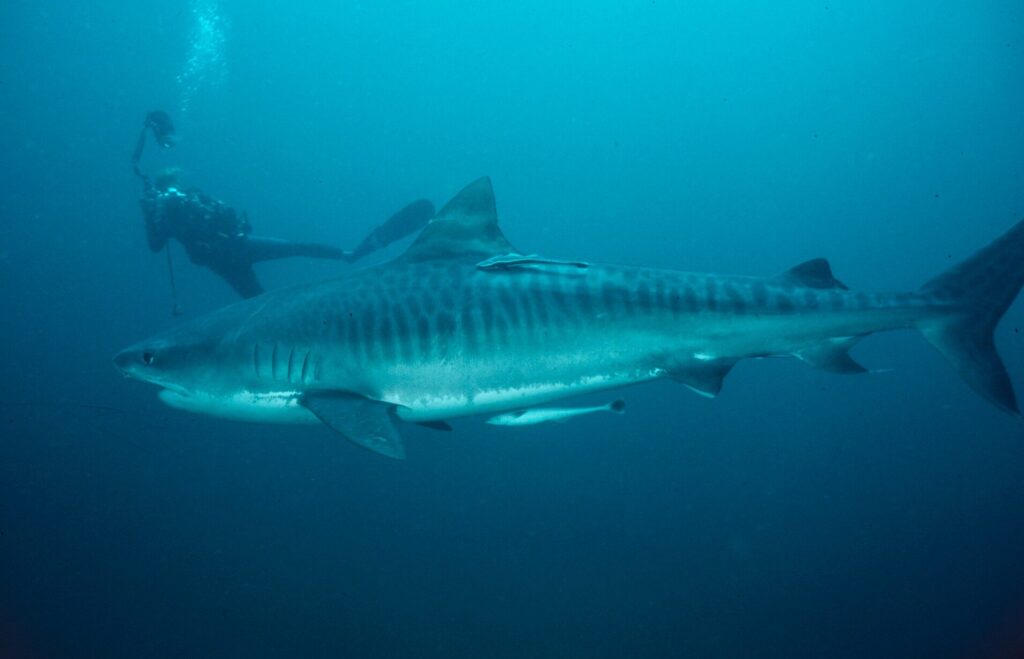
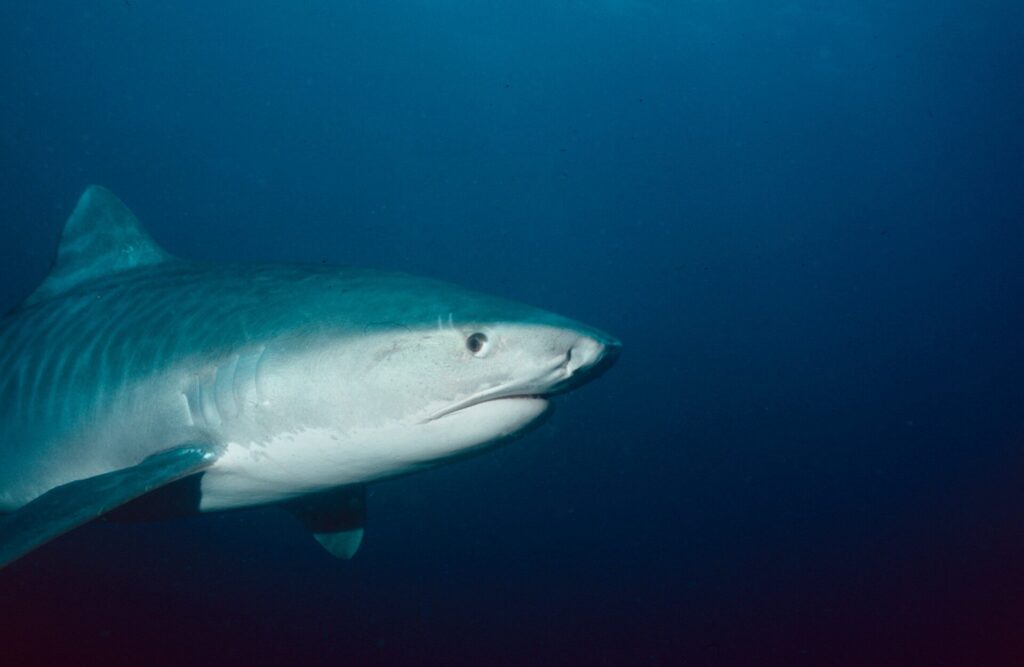
Raffaella is photographing the first tiger as it sniffs the basket and now a second shark approaches her surreptitiously from behind. It grabs the hose of her second stage and pulls it gently backwards as if it wants to play!
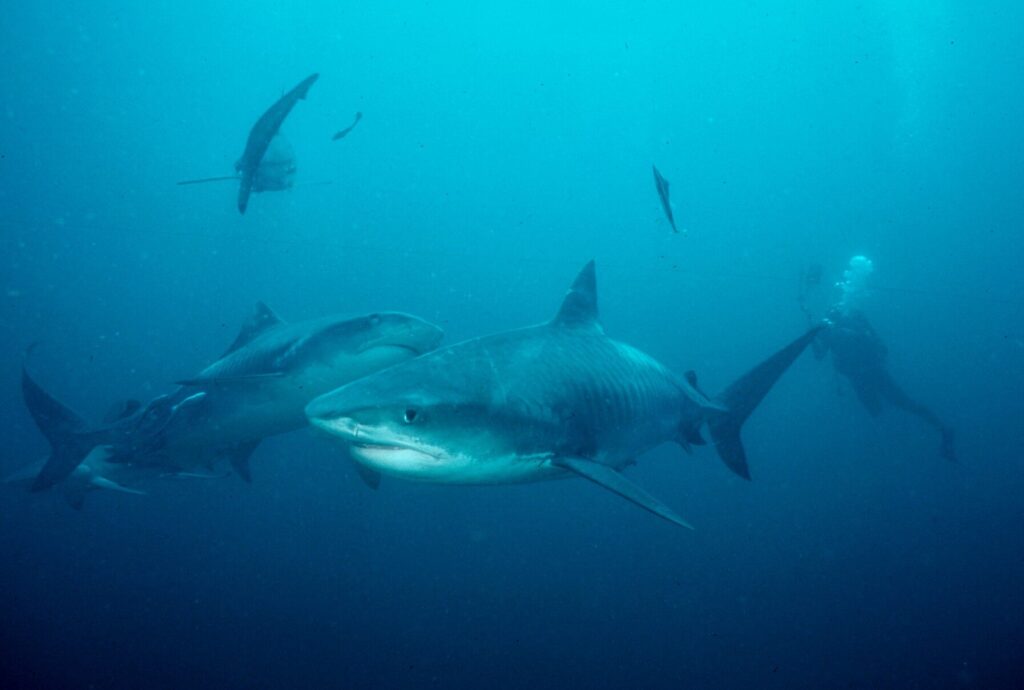
Unaware of the situation, Raffaella believes a diver is trying to attract her attention and brings her hand behind her in an attempt to push away the intruder. The situation has its humorous side.
Dietmar has seen it all and acts quickly to repel the tiger by poking its nose with his stick. Now anxious, he signals everybody to surface. The game is enough. A vivid image that will forever remain in my memory. The rule of the mighty is always law.

Also by Pierre on Divernet: DIVING INTO BIAK’S HIDDEN WORLD OF CAVES, BOUND TO DIVE THE VITU ISLANDS, DIVING INTO CUBA’S FAR WEST, NORONHA: AN ATLANTIC DIVING HOTSPOT, DIVING LIFOU, A FOSSIL ATOLL, FLORES, GATEWAY TO KOMODO and HELL’S BELLS AND OTHER YUCATAN CAVE SPECIALS