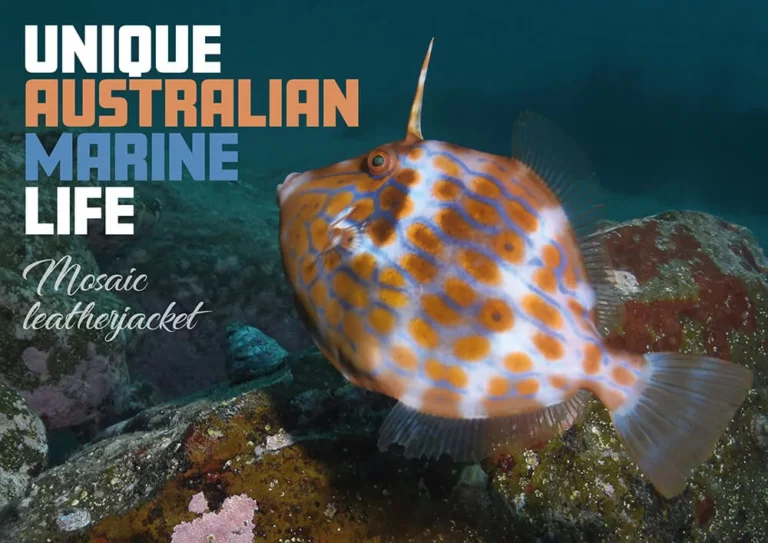
Nigel Marsh takes a closer look at the Mosaic Leatherjacket.
Anatomy and Characteristics of the Mosaic Leatherjacket
Australia is home to the world largest variety of leatherjackets, with 60 species found around the nation. While found in both tropical and temperate waters, leatherjackets are more commonly seen in cooler temperate waters, as many of the tropical species are small and shy. One of most unique members of the family found in southern Australia is the wonderful mosaic leatherjacket.
The mosaic leatherjacket (Eubalichthys mosaicus) has all the typical features of this family of fish. Leatherjackets lack scales and instead have sandpaper-like skin. They also have a defensive spine located on the head above the eyes. Their body shape and size varies greatly, and many of the smaller tropical species are brightly coloured and called filefish. Some of the temperate species also have bright colours, but others have plain colours for camouflage, and a few species even have different colours for the male and female.
The mosaic leatherjacket is one of the prettier temperate species, with its body a bluish grey colour and covered in yellowish orange stripes and blotches, but as juveniles this pattern is still developing so they can appear to be yellow with blue stripes. They are one of the few leatherjackets to have an almost round shape. This species is reportedly found from Perth to Brisbane, but is rarely seen off Tasmania.
Growing to 60cm in length, mosaic leatherjackets are found on rocky reefs in depths to 150m, but juveniles are often encountered by divers in shallow water in estuaries and under jetties. This species has a small mouth with large teeth to help them feed on a range of small invertebrates, including crustaceans, echinoderms, molluscs and even sea jellies.

Where to Find the Mosaic Leatherjacket: From Perth to Brisbane
The mosaic leatherjacket is often seen by divers exploring Melbourne’s Port Phillip Bay and off Adelaide, Perth and Busselton. The author has also regularly seen this species at dive sites off New South Wales, at Port Stephens, Botany Bay, Jervis Bay and Merimbula. A photogenic species, and sometimes curious of divers, the mosaic leatherjacket is another unique Aussie fish to look out for.
Looking for more unique Australian marine life? Check out our guide to the fascinating Australian Pineapplefish (Cleidopus gloriamaris).
“They are one of the few leatherjackets to have an almost round shape. This species is reportedly found from Perth to Brisbane, but is rarely seen off Tasmania.”
Nigel Marsh
Nigel Marsh is an Australian underwater photographer, photojournalist and a buddying marine naturalist. He has a great love of all marine life, no matter how big or how small. He is the author of several dive guides and natural history books, teaches underwater photography and leads special photography group tours. Visit his website for more information. www.nigelmarshphotography.com
FAQS
What is a mosaic leatherjacket?
The mosaic leatherjacket (Eubalichthys mosaicus) is a unique species of Australian fish known for its round body, sandpaper-like skin, and vibrant blue and orange patterns.
Where can you find mosaic leatherjackets in Australia?
They are found in temperate waters from Perth to Brisbane. While rare in Tasmania, they are frequently spotted by divers in Port Phillip Bay, Port Stephens, and Botany Bay.
What do mosaic leatherjackets eat?
Using a small mouth and large teeth, they feed on a variety of small invertebrates, including crustaceans, molluscs, echinoderms, and even sea jellies.
How big do mosaic leatherjackets grow?
The species can reach a maximum length of 60cm. While adults prefer deep rocky reefs up to 150m, juveniles are often found in shallow estuaries and under jetties.
Why are they called leatherjackets?
They belong to the family Monacanthidae, characterized by tough, scale-less skin that feels like sandpaper and a defensive dorsal spine located above the eyes.
This article was originally published in Scuba Diver Magazine
Subscribe today with promo code DIVE1 — enjoy 12 months for just £1!
