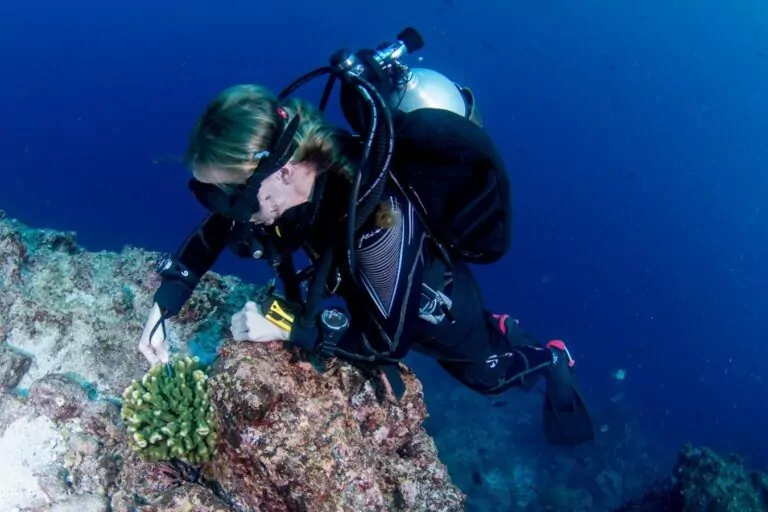
A black stony coral species presumed extinct decades ago has been discovered thriving in Galapagos by scientific scuba divers from the California Academy of Sciences.
Their visit marked the first time Rhizopsammia wellingtoni, which is endemic to the archipelago, had been seen since 2000, when it was classed as Critically Endangered (Possibly Extinct) by the IUCN Red List.
The coral was drawn to the relatively cool water temperatures of Galapagos, where it was first found in shallow waters in 1975, but it disappeared suddenly following the warm ocean conditions brought by the 1982-83 El Niño event.
In collaboration with the Charles Darwin Foundation (CDF) and Galapagos National Park Directorate (GPND), the researchers recorded more than 250 small colonies of the coral across four reef-sites.
The first observation was made during an expedition in January 2024 near Isabela Island’s Tagus Cove, where the species had originally been found. Further reef surveys revealed the species at two other Isabela sites as well as one off Fernandina Island.

The findings suggest that the cooler La Niña conditions of 2020-23 might have offered the coral a reprieve from thermal stress that encouraged it to re-emerge in shallower water.
Recent ROV surveys below 100m have confirmed that the species is also inhabiting mesophotic reefs, suggesting that during the heatwave it might have found temporary refuge in deeper, cooler habitats.
‘Most exciting discoveries’

“Finding something that was previously thought to be extinct is one of the most exciting discoveries a biologist can make,” observed study co-author Terry Gosliner, the CAS’s curator of invertebrate zoology & geology.
“In just one dive, we found more than 100 colonies of R wellingtoni on a healthy, biologically diverse coral reef, many of which were dotted with budding polyps, signalling active reproduction.
“This is huge: evidence that the species isn’t merely clinging to survival, but thriving at multiple localities and depths. This discovery is a hopeful example of resilience amid rising ocean temperatures, and a poignant reminder of what can be gained from continued conservation and coral-reef monitoring in biodiversity hotspots like the Galapagos.”

2025 marks 120 years since the first CAS expedition to Galapagos, when a team of “sailor-scientists” collected 70,000 biological specimens – hard work wasted when these were all but destroyed soon afterwards in the San Francisco Earthquake of 1906.
Today the academy houses the largest collection of scientific specimens from Galapagos, including the original samples of R wellingtoni found in 1975.
The study has just been published in the journal Marine Biology. Lead author Inti Keith, CDF’s principal investigator, commented that the discovery proved that “even the most vulnerable species can persist if we protect the right habitats – yet its tiny, scattered colonies remind us just how close we came to losing it forever, and the critical need for proactive management strategies.”
Samples collected by the researchers are now being studied in the CAS Coral Regeneration Lab.
Coral nurture in Roatan


Elsewhere, on 18 June the CAS opened a coral-rearing laboratory in Roatan, Honduras, said to be the first of its kind in the region. Researchers will use it to shepherd young corals through the vulnerable early stages of life before the hardiest are reintroduced onto the Mesoamerican Reef to boost genetic diversity and resilience.
It is hoped that the low-overhead pilot programme will serve as a model for global reef-restoration efforts.
Also on Divernet: CORAL-SURVIVAL PROJECT OFFERS HOPE IN ROATAN, CCR DIVERS SURFACE WITH DEEP-REEF DISCOVERY, CORAL DNA REVEALS WHO’S THE DADDY, UK DIVER NAMES AFRICA’S FIRST PYGMY PIPEHORSE