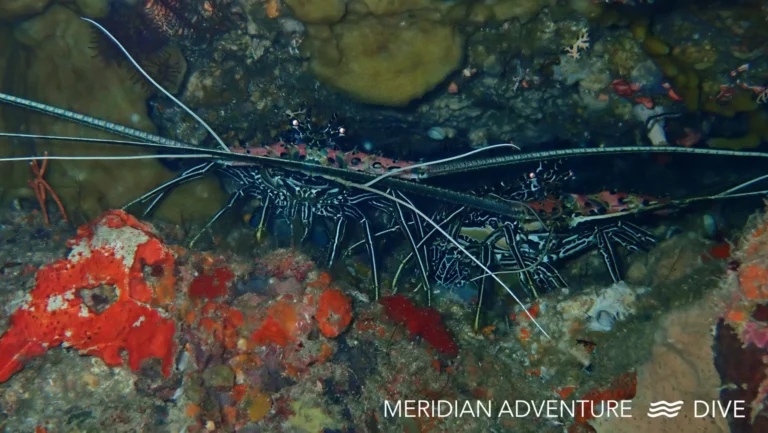
The Painted Lobster is a captivating crustacean commonly seen in Raja Ampat’s tropical reefs. Renowned for its vivid colours and complex patterns, this marine marvel is popular with scuba divers and underwater photographers. Although called a lobster, it does not have the large claws typical of true lobsters and instead uses its long antennae for defence and movement.
Table of Contents:
Fun Facts about Painted Lobster
Origins and Evolution
Appearance and Characteristics
Development and Life Cycle
Breeding Behaviour
Diet and Feeding
Predators and Survival
Life Span and Location
Fun Facts about Painted Lobster
- Painted Lobsters are also known as Ornate Spiny Lobsters.
- They can regenerate lost legs and antennae after moulting.
- Their long antennae help scare off predators and sense movement in the water.
- Painted Lobsters are mostly nocturnal and spend daylight hours hidden in reef crevices.
- Their colourful shells provide excellent camouflage among corals and rocky reefs.
- Juveniles often look very different from adults during early development stages.
- They are highly valued in marine ecosystems as scavengers and reef cleaners.
Origins and Evolution
“Spiny lobsters are evolutionary survivors; their body plan has remained largely unchanged for tens of millions of years, refined to near-perfection for reef life.”
The Painted Lobster belongs to Palinuridae, an ancient crustacean family that evolved millions of years ago. Fossils show lobster-like creatures existed long before dinosaurs. Over time, spiny lobsters adapted to tropical waters and reefs, developing tough exoskeletons and strong tails.
Spiny lobsters, unlike clawed lobsters in colder waters, lack front claws. They depend on speed, armour-like shells, and powerful antennae to deter predators. Their success is evident across the Indo-Pacific, with thriving reefs like Raja Ampat.
The Painted Lobster is vital to reef health, as it feeds on decaying organic matter and small invertebrates, helping maintain the cleanliness and balance of reef ecosystems.
Appearance and Characteristics
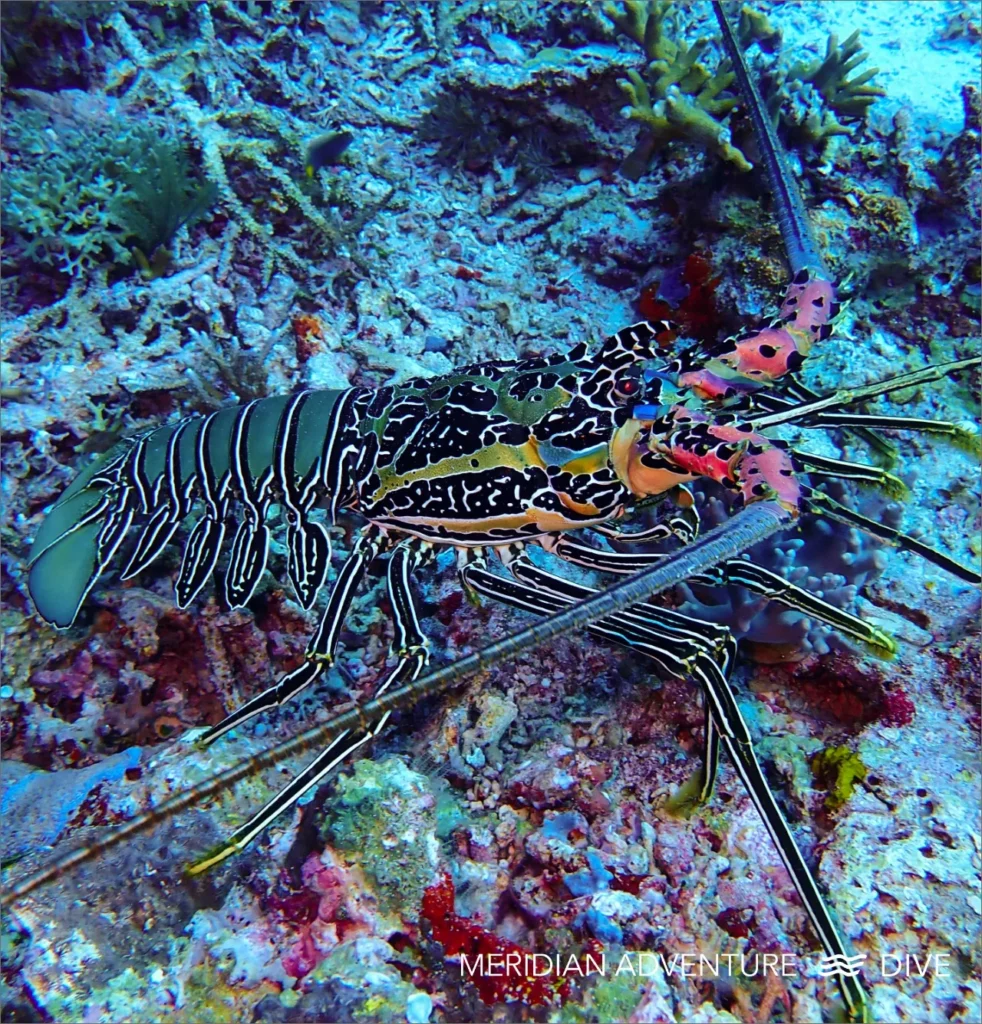
Its carapace and abdomen feature a deep blue-green to purple coloration, adorned with prominent white or pale cream transverse stripes across each abdominal segment. The legs are distinctly banded with alternating dark and white sections, resembling a hand-painted ceramic figure brought to life.
The maximum body length is 40 cm, and the typical adult weight is about 2 kg. It has five pairs of walking legs. Its long, sturdy antennae, sometimes longer than twice the body length and equipped with sharp spines, serve multiple roles: sensing prey and predators and providing active defence through swift whipping. Near the base, two shorter antennules with chemoreceptors are used to taste and smell water.
The exoskeleton is heavily calcified and covered with spines, which makes the animal hard and uncomfortable to swallow. Females can be identified by a small claw on their last pair of walking legs, which is used for carrying and tending eggs.
Development and Life Cycle
The life cycle of Panulirus versicolor is among the most remarkable in the crustacean world, featuring multiple metamorphic stages and impressive oceanic dispersal.
Egg – Carried under the female abdomen; 100,000–900,000 per clutch
Phyllosoma – Transparent leaf larva; drifts for 6–12 months
Puerulus – Post-larva; swims toward the reef; does not feed
Juvenile – Settles on reef; moults frequently; cryptic
Adult – Sexually mature; full colouration; reef-dwelling
Growth occurs through moulting (ecdysis), during which the lobster sheds its entire exoskeleton and becomes soft and vulnerable. During this period, it hides inside reef crevices. As an adult, the moulting frequency drops to about once or twice annually.
Breeding Behaviour
Painted lobsters reach maturity at 2-3 years. Mating occurs nocturnally on the reef, where the male deposits a spermatophore on the female’s underside, between her legs. She later uses stored sperm to fertilise eggs.
Once fertilised, eggs attach to pleopods beneath the female’s abdomen in a mass that can number in the hundreds of thousands. The female is berried during incubation, with the egg mass resembling tiny berries. She constantly fans the eggs to aerate them and is highly protective, rarely leaving the shelter.
Incubation lasts four to eight weeks, after which eggs hatch, releasing phyllosoma larvae into open water for their long pelagic journey. In Raja Ampat, spawning peaks occur during calmer inter-monsoon periods when currents aid larval dispersal.
Diet and Feeding
Painted Lobsters are opportunistic feeders that mostly forage at night. They consume various small marine creatures and organic materials on the reef floor. Their diet typically consists of molluscs, small crustaceans, worms, dead fish and decaying matter, sea urchins, and small reef invertebrates.
Using strong mouthparts and legs, they search sand, rubble, and coral for food. Their scavenging helps recycle nutrients and remove dead matter in reef ecosystems.
Predators and Survival
Painted Lobsters, despite their shells and camouflage, face predators like reef sharks, groupers, octopuses, moray eels, and triggerfish.
To survive, they depend on multiple defense strategies: hiding in reef crevices during the day, blending into their environment with camouflage, making loud rasping sounds by rubbing their body parts, escaping quickly backwards with their strong tails, and defending themselves with sharp spines and long antennae.
Juvenile lobsters are especially vulnerable and face high mortality rates during their early life stages.
Life Span and Location
Painted Lobsters are common throughout the tropical Indo-Pacific, including Indonesia, the Philippines, Papua New Guinea, the Maldives, and northern Australia. Raja Ampat offers ideal habitat conditions with its warm waters, diverse marine life, and extensive coral reefs.
They typically hide under coral ledges, inside caves, and around rocky reef structures from shallow depths down to about 50 meters.
Their lifespan generally ranges from 10 to 15 years, influenced by environmental factors and predation.
For divers in Raja Ampat, spotting a Painted Lobster on a night dive is a memorable moment. Their vivid colors, distinctive look, and intriguing behavior make them among the most captivating nocturnal reef creatures.
Website: https://raja.meridianadventuredive.com/
Meridian Adventure Dive Resort is a PADI 5-Star Eco and IDC Dive Resort situated in the heart of Raja Ampat. It provides expert-led diving at world-renowned sites with eco-friendly boats. The resort offers comfortable, air-conditioned accommodations, high-quality equipment, and outstanding hospitality, catering to divers of all levels in one of the world’s most biodiverse marine areas.
