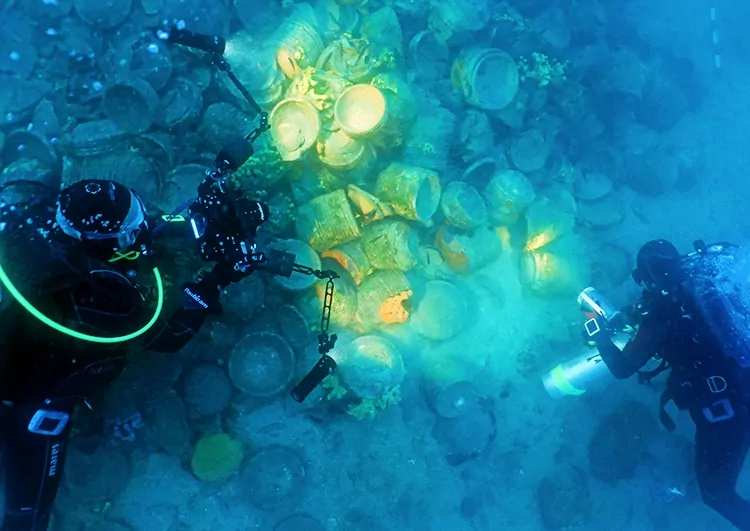
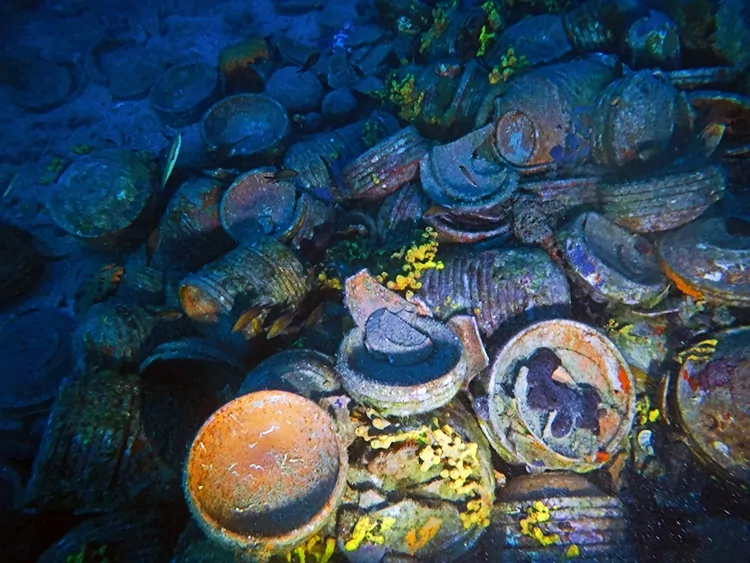
A 1,500-year-old merchant shipwreck containing some 10,000 ceramic plates, dishes and bowls has been found at a depth of 43m off the coast of Ayvalik in Türkiye.
The discovery, part of what is known as the Turkish Shipwreck Inventory Project: Blue Heritage, was made in the Aegean Sea about 4km off the province of Balikesir in the north-west of the country.
Also read: Eagle shipwreck saved Scottish treasures for 166 years
Believed to date to the late 5th century AD, the vessel has been described as the largest “plate shipwreck” ever found in the Mediterranean. It is thought by researchers to have been sailing from North Africa or Cyprus toward Constantinople (later Istanbul) when it sank in a storm, with its open-sea location said to have helped to preserve it over the centuries.
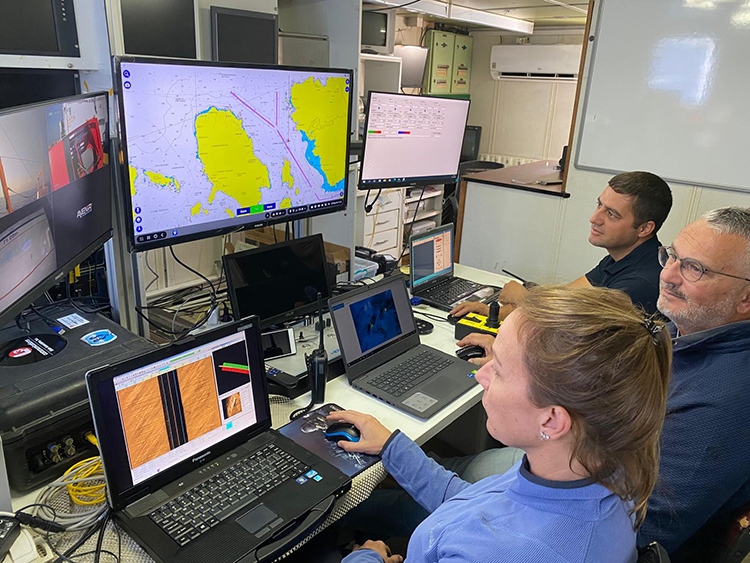
Measuring about 15m long with a 9m beam, the wreck was discovered and investigated by Dokuz Eylul University’s Centre for Underwater Cultural Heritage & Maritime History (SUDEMER) under its deputy director, associate professor Dr Nilhan Kızıldag. They had initially used an AUV to investigate sonar-scanning anomalies before following up with a scuba team.
Also read: Rare sealed amphora set to reveal secrets
The ceramics were found clustered together, often divided into sets of 15 to 20 items. The ship was also carrying a small number of amphoras, the storage vessels maritime archaeologists would normally expect to be the dominant cargo on early Mediterranean trading vessels.
It had been known that ceramics produced in North Africa, Egypt and Syria were taken for trade to Anatolia (Asian Turkiye), Greece or Italy, but the shipwreck is said to provide some of the first clear underwater evidence of such a trade. 10,000 is the number of items estimated from those visible on the wreck, as revealed in photogrammetric studies.
“There are at least five or six different types of plates among the cargo,” said SUDEMER’s director Harun Ozdas. “In our 30 years of underwater research in Turkish waters, finding such wealth is a source of great happiness for us.
“This wreck is of great importance, especially because it has remained untouched and preserved in its original state. The variety and quantity of artefacts here represent a significant collection,” concluded Ozdas, who regards the cargo as worthy of the creation of a dedicated museum in which to display it.
Also on Divernet: DIVERS FIND DAGGER ON WORLD’S OLDEST MERCHANT SHIPWRECK, UNDERWATER ‘TUB’ TURNS OUT TO BE ANCIENT HORSE, 100,000 FINDS ON DEEP CHINESE SHIPWRECKS, THE SECRETS OF THE SVETI PAVAO