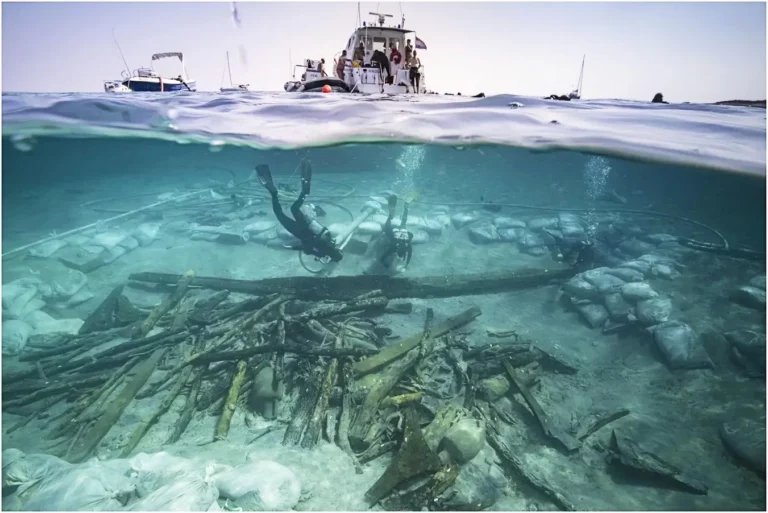
Research carried out on the wreck of a 2,200-year-old shipwreck in Croatia has revealed secrets of how Roman shipbuilders and sailors waterproofed their vessels and protected the hulls from corrosion, shipworms and micro-organisms – right down to where the pollen in the sealing beeswax originated.
Archaeological divers on the Roman wreck known as Ilovik-Paržine 1 provided the samples required by an interdisciplinary scientific team from France’s Strasbourg University.
Sunk around the mid-2nd century BC the sailing ship, designed for use in the Adriatic and further afield, was found in Paržine Bay near Ilovik Island.

The team led by the university’s Laboratory of Mass Spectrometry of Interactions & Systems say that while sealants were long considered of secondary interest to ships’ timbers, sophisticated new analysis techniques have enabled access to the molecular structure of both pure and blended materials used to provide new insights into ancient shipbuilding.
Pitch and beeswax
Shipbuilders and repairers made use of “easily accessible and applicable hydrophobic adhesive material” to reinforce the timber hulls, say the researchers.
Roman author and scientist Pliny the Elder, who died in 79 AD, referred in his Natural History to a combination of pitch and beeswax called zopissa that was used in Greek shipbuilding, and this now appears to have been the first accurate description of organic materials used for naval waterproofing.
The shipyard in which Ilovik-Paržine 1 was built is thought to have been sited near Brundisium (now Brindisi), where there would have been significant contact with the Greek colonies of southern Italy. And the researchers found that zopissa was used as a sealant on the ship, along with pitch (pine tar) applied on its own.
They were also able to analyse pollen within the beeswax to identify the plant from which it had derived and the areas in which it had grown, indicating where sailors had carried out maintenance on the hull.
Batches identified
Four to five distinct batches of sealants were identified. One analytical method suggested that those used at the stern and midships were similar, with three batches identified at the bow. Another identified two batches at the bow, two midships and one at the stern.
The findings reflected either successive repairs or the use of batches from different sources during construction or refitting. Most of the sealants originated from the area near Brundisium where the ship was built.
Claimed to have opened new fields of investigation in naval archaeology, the study has just been published in the journal Frontiers in Materials.
Also on Divernet: Divers explore 2,000-year-old treasures on Swiss lakebed