Last October Divernet reported that marine archaeologists had received the funding that would enable further excavation of a 16th-century Baltic shipwreck carrying barrels full of the iron lumps known as osmunds.
The shipwreck had been discovered in 2017, but only now has the first barrel has been raised – with some difficulty – by marine archaeological divers from Vrak, Sweden’s Museum of Wrecks.
Also read: Divers explore oldest Nordic carvel-built ship
What is now known as the Osmund Wreck left Stockholm for an unknown destination at some point during the 1550s or ‘60s but sank off the town of Dalarö in Stockholm’s central archipelago.

It is now thought to have been carrying at least 20 but possibly as many as 50 barrels full of 300g osmotic iron nuggets thought to have been used as the semi-raw material for forging tools or weapons.
Also read: Divers find missing links to iconic Vasa wreck
The barrel that has been raised will be conserved and analysed in the hope of learning more about 16th-century iron production, trade and shipbuilding. Osmunds have been associated with the first European production of cast iron in furnaces such as Lapphyttan in Sweden, and were exported from the early Middle Ages until the start of the 17th century.

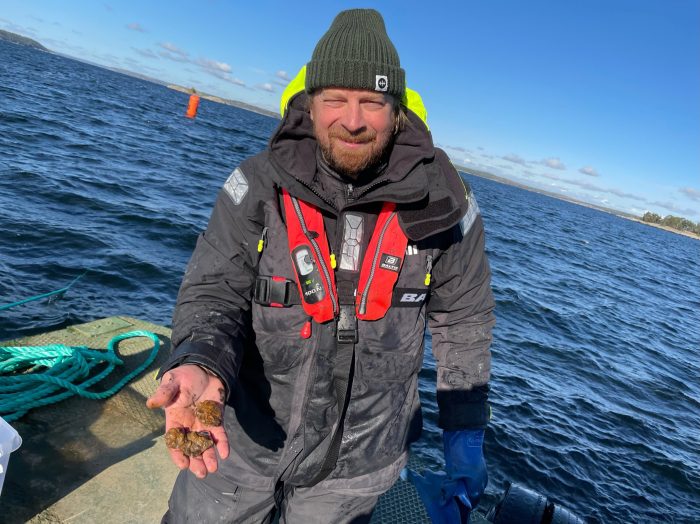
It took two weeks to complete the delicate work of lifting the partially broken barrel, supervised by project manager Jim Hansson from Vrak. He said that its weight and having to work at a depth of 28m to secure it had made the excavation and lift “incredibly difficult”.
Hansson had previously described the Osmund Wreck as unique. “I’ve never seen anything like it – the type of ship is still unknown to us and there are still large areas of the shipwreck and cargo that are unexplored.”

The clinker-built, three-masted Osmund Wreck was 20m long with an 8m beam. Its cargo is thought also to have included large quantities of dried fish as well as deer antlers, which would be used for carving items such as combs.
Sailors’ personal belongings along with galley utensils such as kettles have also been found. Some barrels also contain indeterminate substances that could be anything from butter to tar or potash.

Vrak, located near the Vasa Museum at Djurgården in Stockholm, is part of the Swedish government agency Swedish Maritime & Transport History Museums (SMTM).
The excavation was carried out in collaboration with Jernkontoret, which compiles data on the Swedish iron and steel industry, through a research grant of £120,000 from Swedish charity Voice of the Ocean Foundation.
Also on Divernet: Iron balls draw divers to rare 1500s shipwreck, 2 lions with apple: 17th-century carvings stun divers, Swedish divers survey British Annie shipwreck, Divers date unique Baltic shipwreck, Vrak divers find 10 more Baltic wrecks, 6 historic wrecks ID’d for diver trail