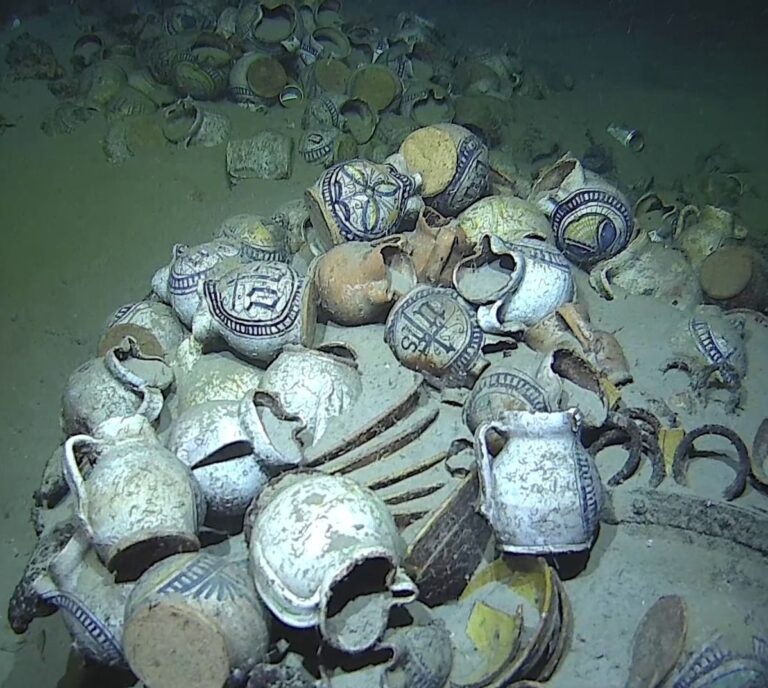
The deepest wreck ever found in French waters has been discovered by chance at a depth of almost 2.6km – and it is thought to be a 16th-century merchant ship that had been sailing west from Italy.
The shipwreck, dubbed “Camarat 4” after the headland Cap Camarat, was found on 4 March off the Mediterranean coastal commune of Ramatuelle, south of St Tropez, and its discovery has just been announced after follow-up research.
A “marine reef control operation” was being carried out by the French Navy’s CEPHISMER team, which specialises in underwater defence and exploration, checking on the nation’s deep-sea resources. The wreck was initially spotted during a sonar survey before an AUV was sent down to obtain close-up imagery of the site.
The discovery was reported to the Maritime Prefecture of the Mediterranean, which in turn approached the government’s Department of Underwater Archaeological Research (DRASSM), responsible for the protection, study and development of France’s underwater heritage.
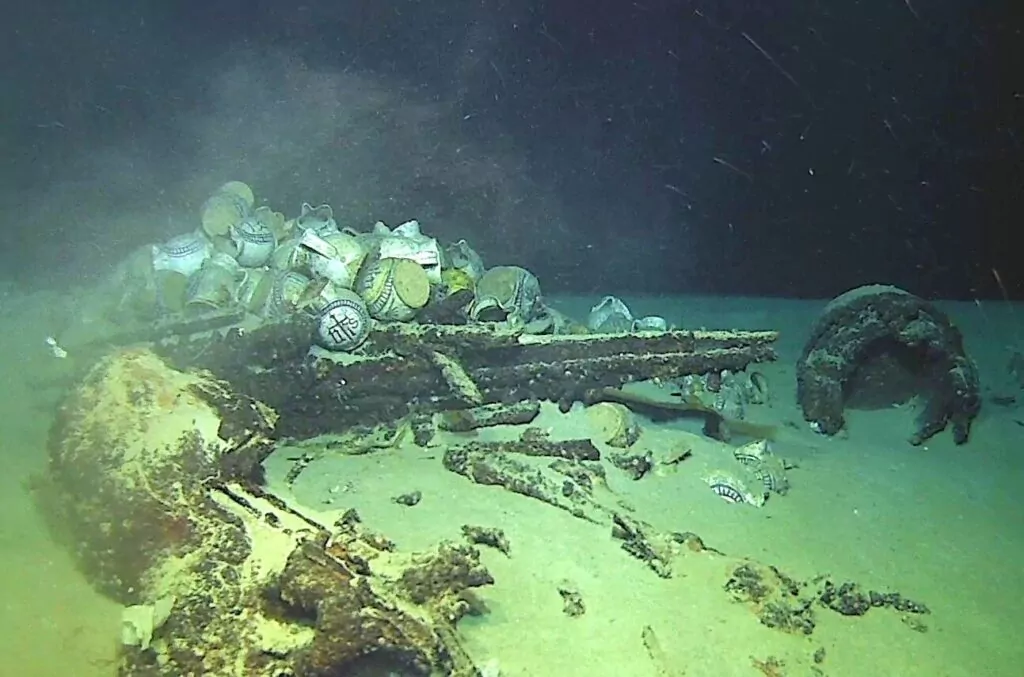
The ship was more than 30m long and 7m wide and was carrying a cargo of ceramic jugs and plates as well as metal bars. Some 200 jugs and 100 plates can be seen in images obtained by the AUV cameras, with many more ceramics thought to lie buried in the sediment.
The jugs are of 16th-century Ligurian design and the yellow plates are also believed to have originated in Liguria. The region lies north-east of the wreck-site in the north-west of Italy, with its Mediterranean coast constituting what is today the Italian Riviera.
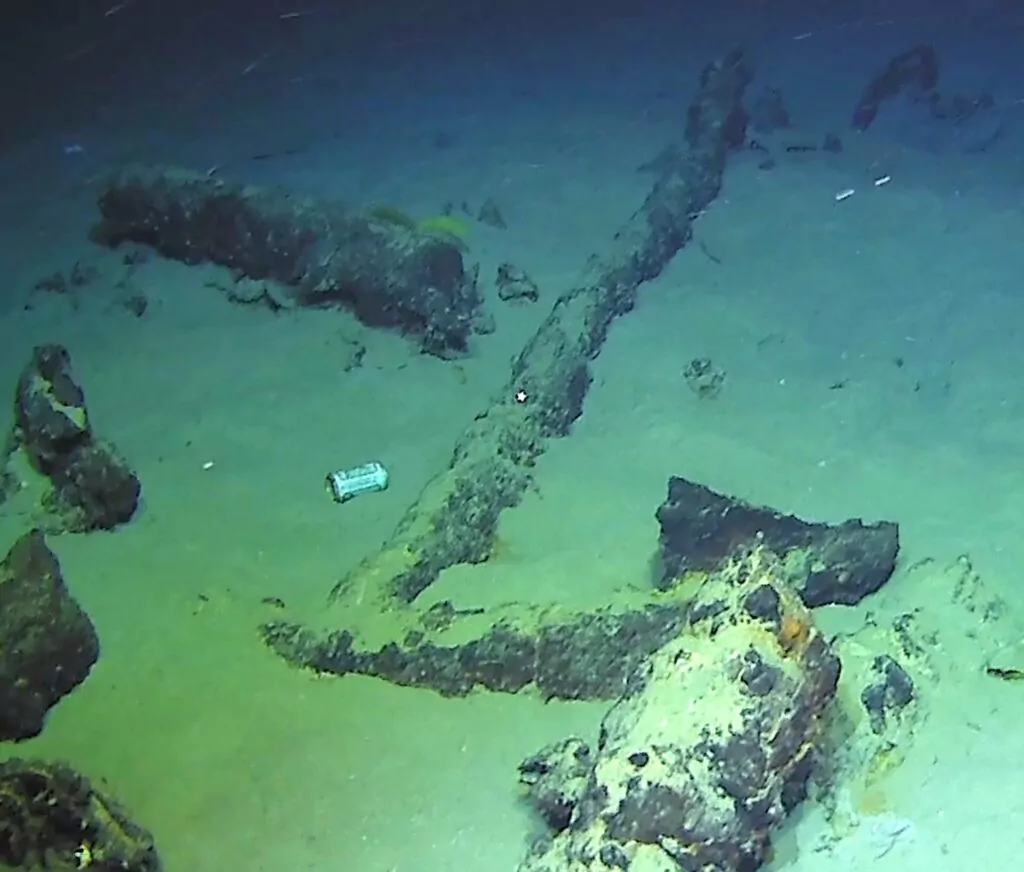
Some of the jugs, which have pinched spouts, carry the monogram ‘IHS’, a shorthand representation of Jesus Christ formed from the first three letters of his name in Greek. Others are decorated with plant-derived or geometric designs, with multiple patterns identified. Anchors, six cannon and two cooking pots have also been identified.
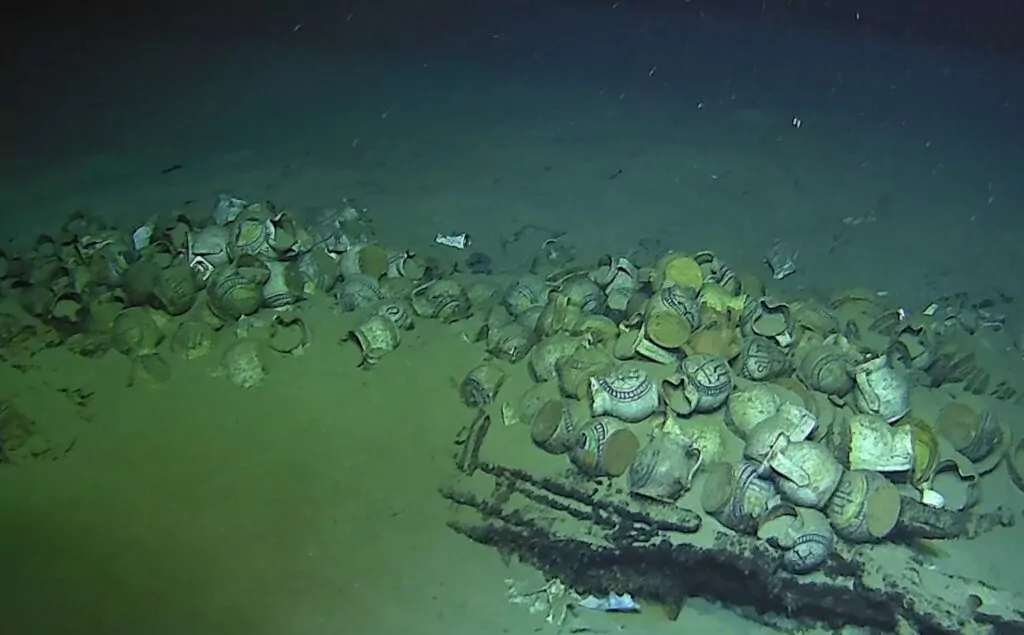
“At this depth the wreck would have been preserved from any degradation or looting, so this is a unique research opportunity,” says DRASSM, which plans to explore further out to the limits of the debris field, complete photogrammetry of the wreck and take selected samples for analysis.
It said that it expected a multi-disciplinary team of maritime archaeologists, ceramologists, specialists in naval architecture, artillery, anchors and materials and conservators to be involved in the project.
The wreck was also said to provide an opportunity to raise awareness about marine pollution, “with both micro and macro-waste present in large quantities at the site” – a modern can can be seen in one of the images.
“Camarat 4 is a remarkable discovery for its depth, unprecedented character and the opportunity it offers to study an almost intact 16th-century site,” says DRASSM, adding that “this wreck constitutes a new step in the exploration of the abyss.”
Also on Divernet: 10,000 ceramics found on ancient Med shipwreck, Diver charged with looting 2,000-year-old shipwreck, Rare sealed amphora set to reveal secrets, Sicily divers probe 2,500-year-old shipwreck