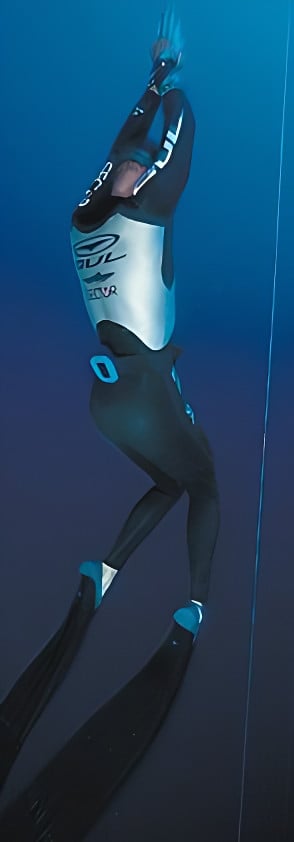
While footballers were breaking English and Scottish hearts in France, our divers were putting up a creditable performance in the Apnea (breath-hold diving) World Cup in Sardinia. That’s them (below) at the opening ceremony, and one of them in action right
By Brendan O’Brien
Pictures by Brendan O’Brien, Antonello Paone and Dan Burton
Just imagine, the Germans arrive with a trimaran, the Italians with massive corporate sponsorship and the Japanese have their vast media circus. The Brits – well, we have a hired beach pedalo!
But hang on, we are relative latecomers to this sport. The team may have begged, borrowed and bartered, but they made it to the World Cup to compete with the world’s best. And what’s more, they’re improving by the metre.
The story goes something like this: five guys answer an advert. Six months later, and with limited training, they are in the Mediterranean at the second Apnea World Cup. Where better to hold such a competition than in the clear waters around Sardinia?
Club Med at Santa Teresa Gallura has undergone a transformation as 130 athletes from 26 teams around the world arrive with their supporters and media entourage.
The driving force behind the competition is the Italian world champion free-diver Umberto Pelizzari and the Association for the International Development of Apnea (AIDA). The first competition was held two years ago in Nice and attracted only six teams. This year’s rise in numbers is a reflection of the sport’s rapid increase in popularity.
Make no mistake, free-diving is a dangerous sport. There were several deaths in the lead-up to the competition: a South African taken by a shark, a Brazilian who hit 45m and kept on going, an American who blacked out in a pool, and a European who suffered a similar fate.
This is a sport in which athletes push human endurance to its limits, and, once there, they discover the complex sensations that feed their addiction. Free-divers talk of the freedom they experience in open water.
Unencumbered by noisy scuba gear, the free-diver is able to flow with the ocean. Our life starts in a liquid environment, develops with holding your breath in the bath as a kid, and continues as an adult in open water.
Just you and your fins reaching out for a tag at depths scuba divers shy away from. Then comes the long ascent, breaking the surface to the cheers of an ecstatic crowd breathless from suspense.
What’s your image of a free-diving competition? You are probably picturing an athlete’s village full of Italians and Frenchmen the size of out-houses handing each other small pieces of tape-measure and remarking, “It does not look much, no? But down there it is everything. Keep this as a souvenir for when I beat you.”
The British team were surprised. “I think we all felt a bit stupid being here with people who could do phenomenal depths,” says Dan Shelverton about their arrival. “Then we found other teams were in the same league as us. Seeing the depths the Italians had put up was a bit demoralising at first, but then it gave us a boost. It makes you realise your potential.”
The official opening ceremony in the nearby town of Santa Teresa Gallura is an Olympic-type affair. All the teams in their official uniforms parade through narrow streets to a passionate reception in the town square. There, officials from CMAS (the World Underwater Federation), AIDA and the local government welcome them to the event.

The crowd erupts at the end of the ceremony to pay homage to the living legend Jacques Mayol. At the age of 71, he is one hell of a guy. Immortalised by Hollywood in the film The Big Blue, his real-life story is even more remarkable. Although he has hung up his competition fins, he continues to take part in apnea, dolphin and open-water childbirth research.
After his speech, there are cult-like scenes of adoration. I have no idea what he said, for that matter I couldn’t understand what anyone was saying. But I didn’t need to, drawn along as I was by the impassioned crowd.
The next day the competition gets started with the constant-weight team event. Safety has always been a massive issue for the organisers, and they are acutely aware that the world’s media are there, ready to record any incidents.
To prevent divers dropping down to unsafe depths, a limit is set at 60m. Divers also have to state an “inscription depth” (their own target). If they go beyond it, they do not score any more points.
If they retrieve the tag at that depth they score a point for every metre. For every metre that they are away from their target, they lose a point from the depth they do attain.
Then there is the ultimate deterrent to prevent divers from pushing beyond their limits. Any diver who blacks out is disqualified from the whole competition, thereby affecting the team’s results.

The diving is from a military pontoon closely protected from any boat traffic or media by a ring of police, coastguard and military vessels. Safety divers are spread out at various depths and on the surface a team of trained doctors and paramedics stands by. Their skills are soon required.
Umberto Pelizzari for the Italian team dives first and comfortably hits his inscription depth of 60m. The next competitor is from New Caledonia with a depth of 58m. He successfully picks up his tag. However, on his return to the surface he blacks out and goes into cardiac arrest. The medic team’s training kicks in and he is successfully resuscitated.
The atmosphere has started to change. There are seven more blackouts in the first two days. Through the various meetings that follow it becomes clear that Pelizzari and the other officials are becoming concerned for free-diver safety and the bad press any incidents could cause.
A blackout is a frightening thing to witness. During the competition there were some mild cases in which free-divers simply faded into unconsciousness. There were also free-divers who suffered whole-body spasms – their backs arched and arms flung out as their bodies convulsed. Without swift medical attention, death can soon follow. The medics are excellent, with every person making a full recovery.
High up in the pecking order is an Israeli team member from London, Lee Donnelly. He learnt to free-dive while working as a diving instructor in the Red Sea. By the time he heard of the British team, he was too late – it had already been selected.
He was soon snapped up by his present team, and with good reason. His depth of 50m puts him in joint fifth place in the constant-weight category.
“Before today my previous best was 47m. I went for 50m and got it!” says Lee. “I feel great now, 60m isn’t far away. I would say that I’m in the top 15 in the world. But I’m not going to stay there for long – soon I’ll be in the top 10, and next time I’ll be on the British team.”
Lee has this to say about free-diving in Britain: “We’re just starting off and have great prospects, there must be more of us that are good enough to compete.”
Lee recently attended a course run by Pelizzari in the Red Sea, where techniques passed on by Mayol were taught. “It’s called autogenic training and involves visualisation techniques so that I can do a lot of my training dry. I visualise how it would look and feel to take the tag off the line. You have to believe in your own ability to succeed.”
While Lee is setting an unofficial British record, the team tries to get out into open water to train. We arrive at the resort’s dock to find that all the boats have been hired out to the big-money teams. The prospect of a mile swim to train is not an appealing one.
But it’s at times like this that true British ingenuity kicks in. Team captain Howard Jones wanders down the beach and returns with a hired pedalo. Three Austrian athletes ask if they can join us. They do and with a two-pedalo flotilla we set off for the deep water a mile offshore.
After a serious pedal out, the British team (who get yours truly and the Austrians to do most of the work) put out lines and float into the seriously clear blue water.
After mental preparation and breathing exercises on the surface, the divers take turns to drop like an arrow into the depths and disappear from sight. The first sign of them returning is the bleeping of their computers screaming at them to slow down. Their spotter is already waiting at 6-8m, the blackout danger zone.
The first to go down is the British team’s best hope, Steve Phillips. He returns to the surface with a personal best of 43m. After he has relaxed for a few minutes, I ask him how he felt. “I’m just glad I’m not dead!” he says, then grins. Sometimes even I don’t understand British humour.

Another personal best is set by John Longman. Only a few months ago his deepest dive was 18m. He hits the surface and launches his arm above his head, “40.3m, man I’m stoked! – 45, that’s what I’m going for now.”
As we pedal back towards shore, waves begin to break over the side. Howard frantically bails out our vessel with his mask. Everyone is in high spirits – the banter full of good-natured abuse.
Dave laughs about how the other teams can’t make them out: “I overheard one athlete saying, ‘The British team, listen, they all hate each other,’ but we’re having such a great time.” Brits abroad, you can’t beat them!
Competition day dawns and the lads are up for it. Dan has his last smoke while the rest sunbathe. Elsewhere some of the other competitors are practising yoga and meditation. All but one of the team achieve their inscription depth.
Howard has problems with his ears, providing the only tension of the day. He fins down, rights himself, clears his ears and then zig-zags down further. No streamlined technique here. The safety divers on the surface are confused, the OK signal goes up, down and hesitantly up again. He returns to the surface safe and well.
It has been an excellent day all round, with no blackouts. “I’m glad I didn’t put down my personal best,” says John. “I just closed my eyes and went for it. When I opened them, there was the tag. It was really hard to blank out all those photographers and cameras. You know that the eyes of the world are on you.”
And what those eyes saw was a British team in 15th place, ahead of free-diving greats such as Australia and Spain.
Back on dry land, the morning’s adventure is nothing compared to the experience that is to follow as I am introduced to “bizarro-world”…

Imagine the scene: holiday-makers relaxing around a resort pool, children playing, aqua-aerobics classes and holiday music coming from the bar. Now include 30 or so wetsuit-clad free-divers. Half of them are sitting around the pool meditating, and the other half are lying in the pool for several minutes without breathing.
What’s this all about then? Face down and starving their brains of oxygen. How can this be a sport? What’s the idea? To see how many brain cells you can destroy before you get to that near-death experience? In fact, this is static apnea – the second part of the competition. There is one point awarded for every six seconds spent with your head under water.
The Italians and French have turned this into a serious discipline – they have reached a point where they can hold their breath for more than seven minutes. How? It’s partly down to the mammalian diving reflex. Howard, for example, can reduce his heartbeat to less than 20 beats per minute due to this quirk of nature.
They lie motionless, covering the surface of the pool. The whole image is a shock to the senses. This is no spectator sport. Perhaps it’s because it all seems so unnatural.
The South African team manager, Tini, sums it all up for me after one of her team has a blackout in the pool. She becomes visibly upset, then shouts, “Look, breathing is normal, not breathing isn’t!” She then proceeds to faint. An empathic blackout?
Still, the medical team is always on hand, closely followed by Club Med staff dressed as Arab terrorists with Schwarzenegger-like water guns. Most of the athletes ignore them and concentrate on huffing and puffing in preparation for their static dive – it sounds like a busy ante-natal clinic.

John can’t resist temptation, however, and sticks his backside out, offering it to the “terrorists” as a target. They take up the challenge and fire at him. In return they are pushed into the pool. Their fake beards drift past seemingly lifeless bodies floating on the surface.
If aliens had landed here, they would be mystified. Forget the aliens, I feel like I’m on a different planet. Then again, this is bizarro-world.
The next couple of days are devoted to more practice for the static apnea day. But there is time in between for play. For the British team, this means “aqua-batics”. This term was coined by the British team and describes free-divers gliding through the water, playing like a pod of dolphins. It is also excellent training for the competition.
“We reckon it could be an Olympic sport,” says Dave. It’s just synchronised swimming under water.” Is this the true mammalian diving reflex? At play like this, they are closer to seals and dolphins than anyone else can be.
There is also an opportunity to become an entry in the Guinness Book of Records. More than 100 “aqua-bats” fill the bay at Club Med to break the record for the greatest number of free-divers under water at the same time.
This includes a Maltese team member who forgot his wetsuit. Being a citizen of bizarro-world, he stands on the seabed at 15m for two minutes dressed in jeans, shirt and shades. At the same time, more than 100 free-divers dart through the water like tadpoles in a small pond.
I never did find out if the record was broken. No one seemed to know, no one really cared. Perhaps that wasn’t really the point of the exercise. For the first time in the competition nearly every athlete had been together where they felt most at home: under water.
“Competitions are just one side of the sport,” comments Howard. “When you’ve got the hang of it, you can comfortably reach 10-15m and have plenty of cruising time. There is so much raw pleasure to be had without scuba gear.”
The last day and it is floating around in the pool time. If the constant-weight category is being at one with the ocean, then I guess static apnea is being at one with a chlorinated swimming pool.
I ask the team what their views are on this discipline. “It’s just the same as any other sport, lifting weights, running 100m. It’s all about pushing your limits,” says Howard, who can hold his breath for more than six minutes. Lee has a slightly different view, “It’s all a bit pointless… static just fills in time, otherwise the competition would be over in three days.”
There had been an important meeting the day before. Pelizzari warns the teams, “The judges are going to be strict about the ‘samba’ [see ‘Freespeak’], they want to see signals from the athletes. No samba!”
There are major safety concerns over this part of the competition.
After all, the athletes are going to hold their breath to the point where their brain will be starved of oxygen. What follows is the possibility of blackout. And then death.
The day goes ahead with a total of eight blackouts. It is an odd sight, grown men and women taking it in turns to play at killing brain cells. This event has got to go. There are other apnea disciplines (dynamic and no-limits, for example) to replace it. Although in some ways as dangerous as static apnea, at least they involve movement.
The British team are performing well. Next it’s John’s turn. However the pressure of the day has got to him. With the world’s media watching him, he has difficulty keeping his oxygen-consuming heartbeat down.

As he goes for a time he has completed comfortably in practice sessions, his body goes into a samba. The medics slap him as his body convulses. With their assistance it takes only a few minutes for him to make a full recovery. However, the disqualification that follows knocks the team from 13th to 22nd place.
They spend the rest of the evening celebrating and throwing anyone that comes near them into the pool. Expecting just to compete, they know that their position is worthy of celebration. Perhaps it was the pedalos that did it?
That’s not the joke it initially seems. These guys are virtually unsponsored and gave up vast amounts of time to train and compete. And the blackout? Isn’t this what extreme sports are all about? If you push yourself to the edge, you run the risk of falling over it.
All too often, athletes demonstrate peak performance in competitions only to take a nose-dive at an all-important moment. The British team have proved that they are serious contenders in the world free-diving arena. Isn’t that cause for celebration?
And the winners are…

1st Italy; 2nd France; 3rd Reunion Island; 4th Croatia. (The British team came 22nd).
Deepest constant-weight free-dive: 60m by Umberto Pelizzari (Italy, pictured left).
Longest static: 6 minutes and 42 seconds by Jean Delmore (France).
Deepest constant-weight free-dive by British national: 50m by Lee Donnelly (competing for Israel).
Longest static by British national: 4 minutes 57 seconds by Dave Audley.
The British team (right, clockwise, starting back left):
Team manager Steve Gardner, Dave Audley, Dan Shelverton, John Longman,
Howard Jones and Steve Phillips.

Further information
British Free-diving Association, c/o Steve Gardner, Meadowside, Albert Road, Hampton Hill, Middlesex TW12 1LB 0181 941 1074 E-mail: free-diveuk@aol.com
The association aims to promote safe free-diving in Britain. It can assist with information on courses held throughout the world by such free-diving gurus as Umberto Pelizzari and Pipin Ferreras. There are also plans to arrange free-diving seminars in Britain.
As with scuba diving, this sport can be dangerous without proper training. Do not attempt any free-diving techniques without receiving proper instruction. Watch out for the QED special on the Apnea World Cup to be shown by the BBC this autumn.
Freespeak
Like scuba diving, free-diving has its own language
Apnea – the term used to describe breath holding.
Constant-weight apnea – on only one breath of air, free-divers attempt to reach their maximum depth. They must be weighted perfectly so that they are able to sink but are not too heavy to fin back up. Free-divers cannot use the line to which the tag is attached to assist them.
Dynamic apnea – involves swimming horizontally as far as the free-diver can on one breath of air. Monofins are a popular means of propulsion, as opposed to normal fins. This may be a discipline included in the next Apnea World Cup to be held in the Red Sea in the year 2000.
Mammalian diving reflex – this phenomenon is common among diving mammals (dolphins, seals, etc). Humans retain this reflex, which causes the heartbeat to slow down when the face is immersed in water.
No-limits apnea – the free-diver descends with the aid of a ballast-filled sled that runs down a line. At the required depth, the diver stops and inflates a lifting bag that assists in the ascent. Currently, medical experts are predicting that death will follow if free-divers push the limits any further. This is perhaps the most controversial form of free-diving, and is not recognised by any official sporting bodies. The record held by Cuban Pipin Ferreras now stands at 155m (with one breath taken during the dive).
The samba – a term used for the first time at this year’s competition. As the body goes into blackout, the arms and legs convulse, giving the appearance that the diver is dancing the samba.
Shallow water blackout (SWB) – caused by a dramatic reduction in the partial pressure of oxygen during an ascent, leading to hypoxia. As a result, the free-diver experiences unconsciousness. There are no indicators to predict the onset of SWB.
Spotter – for safety reasons, free-divers never train alone. Their buddy is referred to as a spotter and will step in to assist if there is any sign of a problem. The spotter is trained in the necessary first-aid techniques.
Static apnea – takes place in a swimming pool, with free-divers lying in a position in which it is impossible to breathe, and remaining in this position until they need to breathe. Towards the end of their attempt, they must indicate to a spotter that they are OK by responding to physical signals.
Static apnea blackout (SAB) – like SWB, this also results in unconsciousness. However, this form of blackout is not due to any pressure changes. Very simply, the brain becomes starved of oxygen.
Yoga, meditation, hypnosis – many free-divers use these techniques to slow their heartbeat and breathing rate. Many practise visualisation techniques to empower themselves with the belief that they can achieve their target. World-record free-diver Pipin Ferreras visualises that he is being injected into the ocean’s depths by a syringe.